Film
Floor 9.5 (2017), directed by Toby Meakins
I haven’t regularly experienced any broadcast advertising aside from baseball radio spots since I got my first TiVo back in 2003. When we watch the baseball playoffs, we’re lightning-quick with the mute button. Life is better, and more relaxed, if you can avoid being lied to all the time in service of commerce.
Yet here I am, recommending an ad. But not in that “the ads are the best part of the Super Bowl” way. This is more the old Texaco Star Theater way, where the brand is paying for you to watch something that doesn’t involve or pitch their product. In this case, it’s an ad for Skittles, and the candy is mentioned in the bumpers. Skittles ran four of these in October 0f 2017, and while the others are all better than watching a standard commercial, they don’t come close to this remarkably efficient little two-minute horror short.
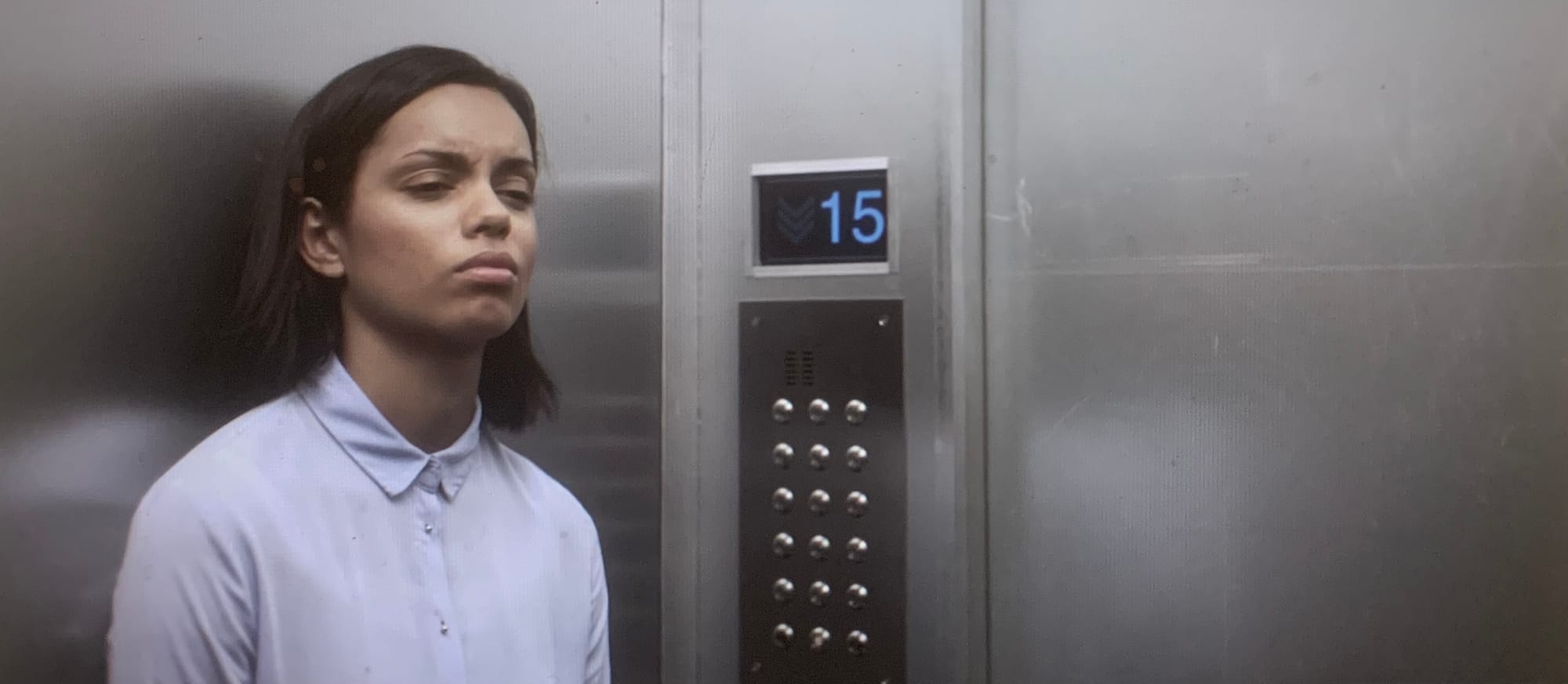
A woman (Georgina Campbell) is heading out of a deserted office late at night (and already, a mere nine years later, there’s a time-capsule quality to this, conjuring up the pre-pandemic era when, if you had to work late, you had to do it at work, often alone). She’s clearly wiped, leaning her head against the elevator like she needs to snatch every single second of rest she can get.
Then the elevator gets weird, flipping between the ninth and tenth floors before finally stopping. The doors open, and . . .
Like the elevator, I’ll stop there. All I’ll say is that often the heart of a horror story is a realization that you’ve entered a place where the rules are different, and figuring them out is the challenge. The moment in this film when we and the protagonist, at the same instant, figure out the very specific rule governing the situation in which she’s found herself is spectacularly well handled.
Story
“The Inner Room” (1988), by Robert Aickman
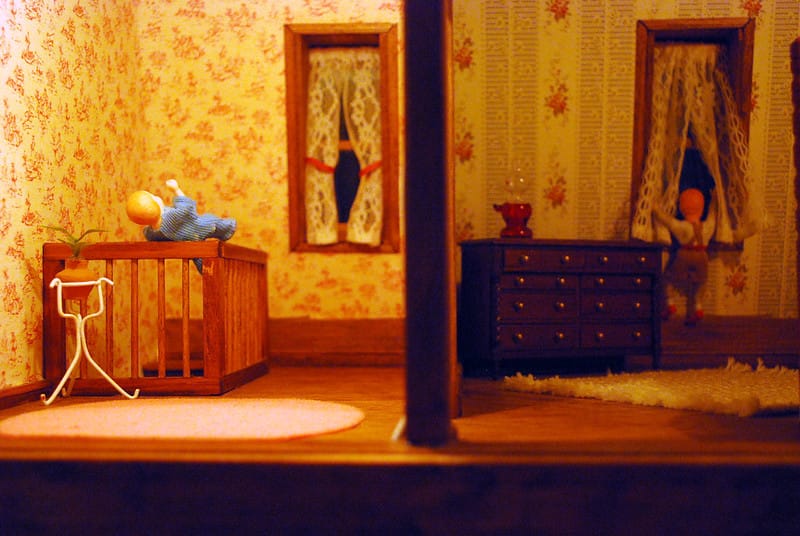
It’s no wonder that dollhouses and their inhabitants are a common resort of the writer of weird stories. The houses themselves offer the complicated thrills of voyeurism, at the same time as their static qualities inevitably suggest abandonment, dereliction, decay, a reminder that the beloved objects with which we surround ourselves in life will, when we’re gone, revert to their inert, meaningless state.
Then there are the dolls themselves. Imbued with life by an engaged child, they can come very close to magic. Pull that attention away, however, and their glassy eyes become reproachful, their poses excruciating, their simulacrum of humanity a mockery. Few things are creepier than a neglected doll.
Robert Aickman usually didn’t work with such common materials. His weird tales are generally more quotidian. The typical Aickman story features as its protagonist an ordinary person—a regional manager, say—who gets unexpectedly stuck in a nondescript English town and there encounters . . . something . . . both out of the ordinary and entrapping. Ritualistic. Ancient, perhaps. Definitely threatening, but also often at least somewhat hard to pin down. Aickman’s stories enact versions of the feeling of being stuck in the Molasses Swamp of the everyday. Their protagonists tend to be people who have been going through life thinking, with ever less conviction, that they’ll eventually get to a crossroads. Instead, life shunts them into an inescapable roundabout.
Aickman doesn’t go in for big effects or explanations, working more in the tradition of The Turn of the Screw than of Poe or M. R. James or E. F. Benson. His stories are more subtle. “An Aickman story,” writes Victoria Nelson in her introduction to the collection Compulsory Games, “is a dream you never wake up from.” The stories do share many of the metaphorical, masked qualities of dreams. Freud lurks in these stories, though not explicitly. So does sex. Rarely do you finish an Aickman story and know exactly what has happened. At the same time, rarely do you finish one and shake it off quickly.
“The Inner Room” is related by a woman who seems to be beyond late middle age. It opens with a memory of her childhood in the early 1920s. Rereading it today for the first time in several years I was struck by how effectively Aickman uses details in the first half of the story to efficiently convey the family dynamics. The narrator’s mother, an immigrant from Germany, supports the family by teaching the German language in five different schools. Her father, a wastrel, gets and loses vaguely sketchy jobs with regularity while nonetheless operating with a wholly unearned masculine bravado. They are getting by, but much is being left unaddressed.
In a shop “that at the best sold too much of what no one wanted” in an unnamed town in which the family is briefly stranded after their car breaks down (again), the father buys the narrator a dollhouse, gothic and gloomy. “A lady brought it in and said she needed to get rid of it,” the proprietor says, explaining why he’s asking only a pound for it. When they get it home, the protagonist discovers that it’s not a modern dollhouse with a hinged front. It’s wholly closed off; all she can do is look in the windows. She discovers a scene of moderate disrepair, a terrifying portrait of a patriarch, and nine dolls. One of the dolls strikes her as looking like she’s been driven mad. Oh, and there’s no kitchen.
A few weeks later (which, in the narrator’s telling, includes one jump into the future via a death-dealing parenthetical worthy of Muriel Spark), her scholarly, methodical brother (whom we later learn, fittingly, becomes a Jesuit priest), undertakes to sketch out the rooms of the house for a school project. Through which he discovers that there must be another room at the center of the house that they can’t see. He tells their mother.
That should be enough to get you going. The next places Aickman takes his story are best experienced wholly fresh.
Song
“Monster Mash” (1962), by Bobby “Boris” Pickett
Sometimes the ubiquity of a song can obscure what’s interesting about it.
Bobby Pickett, actor and singer, was performing one night with his band, the Cordials, and he broke into a Boris Karloff imitation. Apparently it slayed, because his bandmate Lenny Capizzi suggested they try to work up a song using that voice. The result was released in August of 1962 and quickly hit number one. It’s been in our heads ever since.
But let’s think for a minute about all that went into this novelty song. Here’s a partial list:
- Dance crazes: The song is riffing on the appetite for named dances that had caught fire with the success of Chubby Checker’s cover of “The Twist” two years earlier.
- Which was a thing because there were a staggering number of baby boom teenagers who needed ways to safely interact with members of the opposite sex in public.
- Monsters: Pickett, whose father was a movie theater manager, is drawing on the Universal Monsters of the 1930s and ’40s.
- He’s imitating Boris Karloff, an Englishman born in 1887. Which was already almost seventy years after the invention of the monster who would give Karloff his lasting fame.
- The lyrics also mention Dracula, a character from a novel which was by then sixty-five years old and built on legends much older. Which gives Pickett a chance to imitate Bela Lugosi, a Hungarian born in 1882.
- Pickett throws in an imitation of Peter Lorre as Igor, a lab assistant who emerged from multiple characters across 1930s horror films and is now universally familiar. Lorre was also born in Hungary, though a generation after Lugosi. But he never actually played the role of Igor.
- Oh, and then there’s the werewolf (Lon Chaney, born in 1883 in Colorado Springs), whose affliction was recorded by Petronius as early as 27 CE.
All that’s without even getting into the structure and instrumentation of the song, with their debts to African American song forms and imported and adapted African instruments.
“Monster Mash” is a silly song. It breaks no ground. But the way it takes in and repurposes so many strains of culture from across so many eras, and does so wholly unthinkingly, is one of those things that pop culture will always have over high culture.
Administrative stuff
If “The Inner Room” didn’t sate your taste for weird tales you can check out a list of ten (plus some also-rans) that I recommended at Medium way back in 2014. And if you want more weird, small rooms, check out Madeline Yale Winn’s 1895 short story “The Little Room.” Then read a couple of old blog posts of mine in which I connected with a person who had seen the actual room in question. If you haven’t had enough creepy dollhouse scenes, I can recommend The Nutshell Studies of Unexplained Death, which presents dollhouse crime-scene recreations from the 1940s and ’50s by Frances Glessner, who founded the Department of Legal Medicine at Harvard.
The link to the Robert Aickman collection The Wine-Dark Sea above takes you to Exile in Bookville, one of my regular local haunts. On the second floor of the Fine Arts Building on Michigan Avenue, it’s a compact, remarkably well-curated shop that is near the top of my list when visitors to our city ask me what they should check out.
Carried over from last issue
A few issues back, I wrote about the 1973 crime film The Outfit, which is based on Donald E. Westlake’s novel of the same name. The reason I had recently rewatched it was for a project I wasn’t able to talk about then, but am happy to tell you about now: Back in January a video crew came over and interviewed me at home about Westlake’s work and career for the extras of a new UK Blu-ray release of the film. It’s available now, and it’s a really well-made package, with original artwork, multiple essays, and an alternate ending. (I’m on a DVD with Marie Windsor!)
I’d be remiss if I didn’t use this opportunity to also make sure you know about the Westlake book I edited: The Getaway Car: A Donald E. Westlake Nonfiction Miscellany. And while I’m in selling mode—the holidays loom, after all—I’ll also note the book that my wife and I edited together: The Daily Sherlock Holmes: A Year of Quotes from the Case-Book of the World’s Greatest Detective.