Film
The Tall T (1957)
Watching a Western these days shares some qualities with experiencing an unseasonably warm day in the depths of winter. You know that at some point in the past you were able to enjoy such a thing wholeheartedly, but now there’s an undertow. External factors make pure joy impossible. You can still take pleasure in it, but that pleasure vies with the knowledge that all is not as it seems.
The Western is a genre of lies, ersatz and self-mythologizing even at its origin. It has racism and genocide in its bones. The pioneer myths it celebrates remain perniciously powerful in everyday life in America today. Even Westerns that feature no Native Americans are telling stories that rely on their erasure, tales of empty lands awaiting the guiding hand of white men. Not even The Harvey Girls can escape complicity. That there have been dissenting voices within the genre almost from the start, glimmers of awareness here and there, doesn’t change the larger picture.
The Western is not alone in this, of course. As Edward Said pointed out in Culture and Imperialism, the manor of Mansfield Park in Austen is paid for by slave labor on Antigua. “There is no document of civilization,” Walter Benjamin noted, “that is not also a document of barbarism.” The Western, however, was built not on eliding, but on dramatizing that brutality, romanticizing the side aligned with power in the ruthless wars of conquest that opened the West to white settlement. That’s a different order of problem from idly wondering about what exactly backs the five per cents that fund the lifestyle of a character in Trollope.
Yet every winter, when the dark nights draw in and the cold confines us to quarters, I find myself wanting to watch Westerns, to be out in that oh-so-American landscape and its stories for a while. Despite all the flaws, the genre still has something to offer. At its best, the Western dramatizes the challenge, and value, of moral choice. Even in an ethically tainted setting, individuals can make decisions that are in themselves good or bad, honorable or dishonorable. Tested in a violent setting, characters show what they’re made of. Do you look out only for yourself, or are you willing to bear risk to protect others, your community? At a time when questions like “What would you do if . . . ” seem closer than they have before in my lifetime, that type of drama can be powerful.
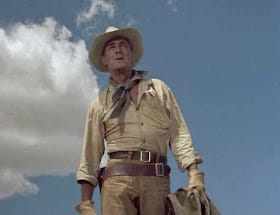
Which brings me to The Tall T. It’s the second, and best, of seven lean, low-budget films from the mid-1950s in which director Budd Boetticher teamed up with actor Randolph Scott. Dave Kehr describes them as “among the major glories of American movies,” and I’m in his camp. The films feature enough similarities to tempt generalization, enough differences to defeat it. But in broad terms the best of them pit Scott, a loner wrestling with a tragedy in his past, against a group of outlaws who have reason to want to kill him . . . but not quite yet. For a while, they need to keep him alive, as they journey with him through a forbidding landscape or wait for a ransom. The drama, and the draw of the films, is in watching Scott calculate the angles, figure out when his opponent will make his play, and how and when Scott can make his own, to protect himself, and, crucially, others in the party who can’t protect themselves. The creed of these films—so important it’s spoken in two of the seven—is, “There are some things a man can’t ride around.” Our responsibilities are there. We just have to be brave enough to take them up.
Scott was a charismatic, handsome, rangy actor who was aware of his limited dramatic gifts and worked within them. In these films he plays loners. Every hero in these films, Hannah Long wrote for the Bulwark, “starts the story lonesome.” He’s unhappily at home with violence, taciturn and stern, but sympathetic to the plights of others. “The Boetticher hero is brave,” Long notes, “but he has no bravado.” In Seven Men from Now he seems not to begrudge the theft of his horse by a band of Chiricahua who, pushed out of their lands and fighting hunger, took it to eat. In multiple films, he strikes up conversations with young men who are working for his gunman antagonist. There’s utility in those conversations. He’s looking to drive any wedges he can. But there’s also true interest—these men are lost, without anchors or purpose, and he gently tries to help them see that. Scott’s characters may be solitary, but they have found a path that makes their duty clear. That’s not nothing.
The Tall T distills all these qualities to a chamber drama where the chamber is a rock-strewn wilderness at the edge of a mine. Scott is a prisoner alongside a woman whose husband cravenly lit out for safety at the first opportunity. For 78 minutes we watch him try to keep the two of them alive long enough for Richard Boone, playing the outlaw with a self-awareness and charisma that leads us right to the edge of sympathy, to slip up. It’s tense and terse, a battle of wits and words long before it becomes a battle of guns. It’s as good as Westerns get.
Book
Doc (2011), by Mary Doria Russell
There’s a reason that for more than a century now the genre has returned to the well that is the Earp brothers. They’re so American. Chancers who mostly ended up on the right sides of battles fought between shades of gray. Capable, and, far more important, lucky. Restless to the point of rootlessness, always looking to the next thing. Self-mythologizing almost in the moment. Stumbling into things, and mostly stumbling through them to success.
The gunfight that cemented their place in history is typical. The Earps represented the law, but they also could have chosen to eschew enforcement by violence. They didn’t, and the result, playing out over months of subsequent killings, was nothing short of a tragedy.
Had Doc Holliday not walked down to the O. K. Corral with the Earps, we wouldn’t know his name, and the Earps themselves would be far less interesting. He’s the catalyst—the educated, cultured, wry, death-haunted Southern gentleman foil to their brash, virile, headlong Northern masculinity. Mary Doria Russell is interested in how such an unlikely friendship developed. To answer that question, she makes the O. K. Corral but a footnote, instead going back before Tombstone, to a Dodge City thickly populated with rogues and seething with intrigue, a growing town on the make in a post–Civil War West in which politics and violence are tightly entangled, and the meaning of a badge can change depending on who’s wearing it. Who has integrity? Who keeps their word? What direction is the money flowing? Who will hold fast in the face of threats? That’s the story of Dodge City in 1878 as Russell tells it.
Wyatt Earp, as he did multiple times, finds himself almost by accident a lawman, his brothers Virgil and Morgan at his side. Holliday, meanwhile, is a recent arrival to Dodge, known as a killer and a drunk and a gambler and a dentist and a lunger, in ascending order of accuracy. He’s in Dodge City for his health, and the dusty town is not obliging. But through his connection with the Earps, his time there offers him, Russell shows, “a single season of something like happiness.” He’s a man adrift, and what attracts him, in fits and starts, to the Earps, is their loyalty to one another, the sense that if he could get even to the edge of their circle of brotherhood, he’d find community. What they find in him is a man of integrity, fiercely proud, wholly unafraid, and deathlessly loyal. In Tombstone, a 1993 film that tells the Earps’ story, someone asks Holliday why he fights alongside them. “Wyatt Earp is my friend,” he replies. “Hell, I got lots of friends,” says his questioner. Holliday replies, “I don’t.” He’s willing to die for the ones he does.
While Westerns on film have long held a place in the canon, prose Westerns have never been accorded much respect, suffering as they do from being both genre fiction and historical fiction. Chandler and Hammett elbow a space for crime fiction in the canon in part because we can tell ourselves that under the genre trappings lie some truths about the interwar world. We can’t make a similar case for the inherently backward-looking, inevitably romanticizing Western novel. Doc isn’t trying to escape that. It’s romantic. Russell loves Holliday, and she wants us to love him. She’s clear-eyed about the myths of the West, but she also knows full well that they’re what brought us to this book. Nonetheless, sentence by sentence, character by character, Doc is rich in insight and movingly convincing about the lives it depicts. As I closed it after re-reading it this month, I was willing to believe that Russell had extricated from the myths at least some of the real Doc Holliday.
Music
Cattle Call: Early Cowboy Music and Its Roots (Rounder Records, 1996)
Don’t Fence Me In: Western Music’s Early Golden Era (Rounder Records, 1996)
Stampede! Western Music’s Late Golden Era (Rounder Records, 1996)
Because these CDs appear to be out of print, I’ve made a playlist that includes all the songs from them that I could find.
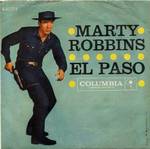
Across three CDs, this collection traces cowboy music from the earliest days of recording into its highly polished postwar heyday. The first track, “When the Work’s All Done This Fall,” a sentimental ballad about the stampede death of a cowboy, recorded in 1925 and based on a poem from 1893, is spare and simple enough to call to mind the field recordings John Lomax was making in the period. It’s a hundred years old and feels every bit of it. By the time we get to Marty Robbins’s “El Paso” on disc three, thirty-four years later, everything is different—recording technology, lyrical and melodic complexity, production quality. The music, just like the world around it, has been professionalized.
The search for authenticity is at best a mug’s game, at worst the quicksand of a pedant’s Key to All Mythologies. Early and late, crude or polished, it’s all cowboy music. The best way to experience it is simply to sink in and enjoy this odd little byway of American culture. Hear Jimmie Rodgers (himself a lunger) implant the idea of the yodeling cowboy, then Tex Ritter cement it with “Cattle Call,” a song he wrote one night as he watched the snow and felt pity for cold, wet livestock. Revel in the close harmonies of Roy Rogers and the Sons of the Pioneers, and marvel that not long ago America had space for two superstar singing cowboys, with countless more ready in the remuda. Smile at Ned Washington’s rhyming of “state’s prison” with “my life or his’n” in the lyrics of “High Noon.” Enjoy a genre that can accommodate a high-drama minor-key story-song like “(Ghost) Riders in the Sky” alongside a bauble like “I Wanna Be a Cowboy’s Sweetheart.” The latter is just one of a number of songs by women in the collection, a welcome corrective to the rest of the Western genre, where women are usually objects or afterthoughts.
Oh, and of course you get some Cole Porter, too. It’s January. Half of winter is still ahead. Let’s ride to the ridge where the West commences, and gaze at the moon until we lose our senses.
Bonus film note
O. K. Corral movies, ranked
7 Frontier Marshall (1939). I love Randolph Scott, but he’s too upright to be a convincing Earp, and the less said about Cesar Romero’s Doc the better.
6 Doc (1971). A film totally caught up in New Hollywood–style myth-busting, dark and dirty as if it had been filmed through a trail-worn neckerchief. Stacy Keach is mostly inscrutable as Holliday. The Pete Hamill screenplay has its moments.
5 Hour of the Gun (1967). James Garner has the charisma to be Wyatt, but not the slipperiness. Jason Robards can’t convince us that Doc is on familiar terms with death. The whole thing, like so many movies of that era, is lit as flat and bright as a game show.
4 Wyatt Earp (1994). The deserving loser of the early ’90s Earp films match-up. Costner isn’t capable of suggesting the nuance of Wyatt. Gene Hackman as Daddy Earp, however, is inspired casting.
3 Gunfight at the O. K. Corral (1957). Burt Lancaster as Wyatt, Kirk Douglas as Doc—you can see the problems already, right? John Ireland makes a sly Johnny Ringo, though, and Jo Van Fleet a solid Kate.
2 My Darling Clementine (1946). Henry Ford plays Wyatt fuddled and goofy, which works. Victor Mature plays Doc like the only adult in the room.
1 Tombstone (1993). The cast is perfect. Kurt Russell’s dumb, bewildered heroism befits Wyatt, while Val Kilmer’s fey, corpsish Doc is one of the great performances of our era. The movie honors the undramatic shapelessness of the Earps’ story in a way few do.