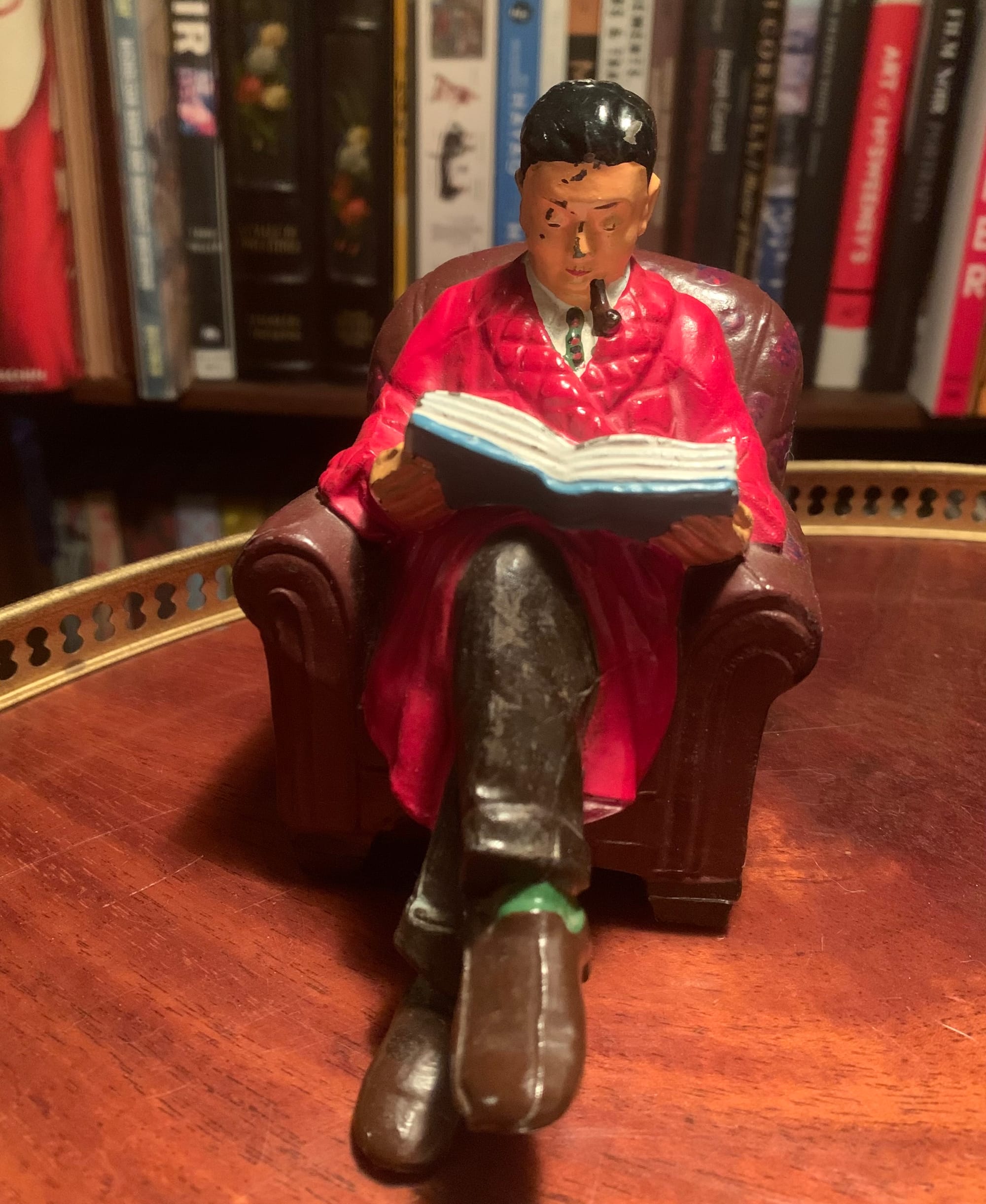
Breaking format for this issue because my head and my time have been all wrapped up with the shelving project that inspired this post. Ben Hecht supplied the title. This week’s bookstore, to which titles of the in-print books are linked, is the lovely new Time and a Half Books, just down the block from me.
A friend of ours who lives in a house full of surprising and unusual antiques and oddities says one of her goals as a collector is to leave behind a memorable estate sale.
No sensible collector who’s reached midlife can avoid the question of what’s to happen to all their stuff—and, following from that, the question of whether they should continue to collect at all now that they’re so far along. Most collections don’t survive their creator’s death, with dispersal to other collections the best outcome, the landfill the most likely.
As anyone who’s visited our house can attest, we do collect, on a modest scale, oddities and art. But mostly what we collect is books. And there are few collections whose value disappears so completely as part of an estate than books. The books on our shelves, almost all reading copies, rather than rarities, have value so long as they’re part of our home. Once that home is gone, no one will want them.
So why, in a world where libraries exist and shelf space is finite, keep buying them? One reason is simply that I’ve always been a bookstore person. I like to drop in at shops, say hi to my friends, and see what they recommend. I’m not going to stop doing that.
Nonetheless, I thought to myself as I lugged 229 shopping bags full of books downstairs last month so that we could have the shelving in our front library redone, I could buy books but not retain them. Little Free Libraries are thick on the ground in my neighborhood.
But then I spied this shelf, on which had been gathered some stray books that had been mis- or unshelved, and I thought, this, a microcosm of an ordinary book collection, offers examples of the what's nice about having a house full of books—a sample of what kind of books a browser will find, and what they offer.
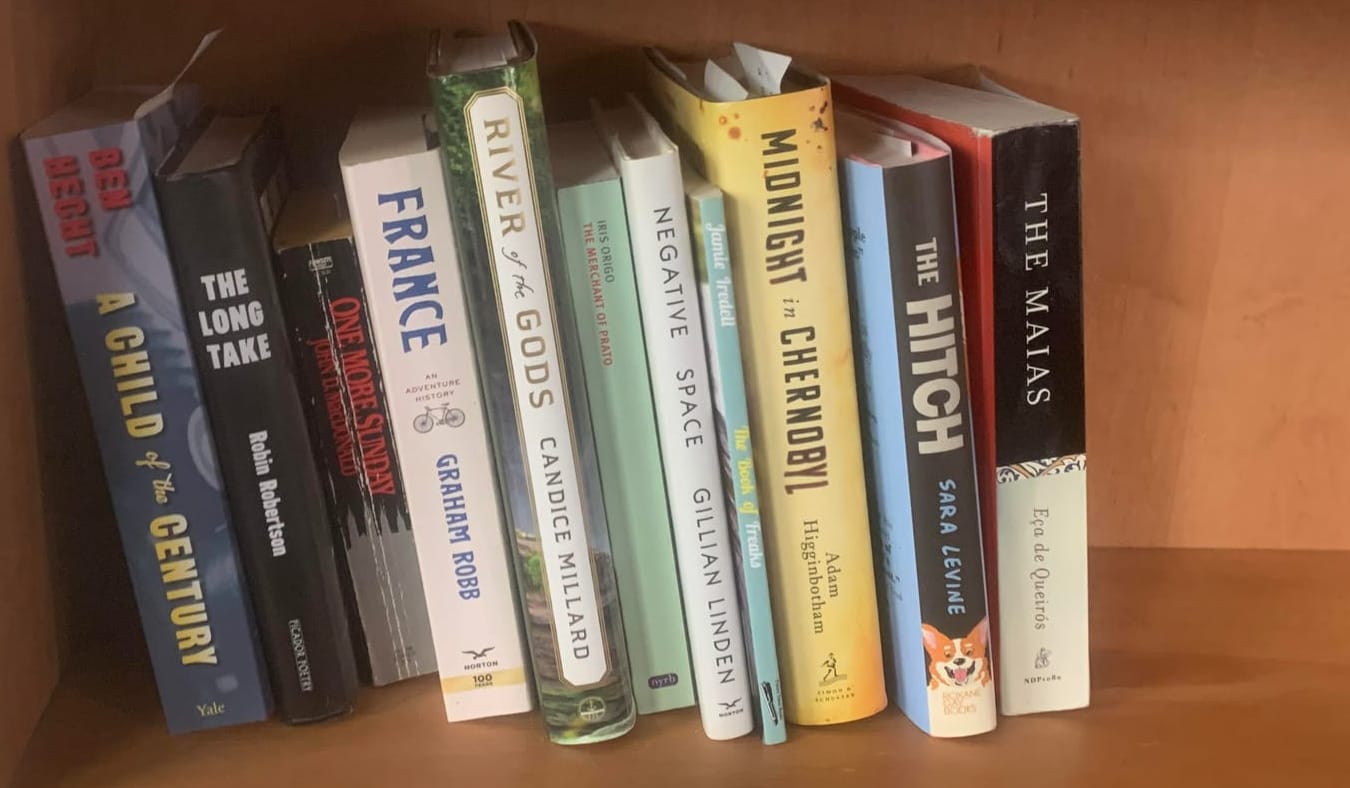
The books that are for keeping near and dipping into
A Child of the Century (1954), by Ben Hecht
Some books you read straight through. Others pall at length, but shine in snippets. A book that opens with a disclaimer like this is telling you it’s in the second category:
The reader has certain expectations of an autobiographer. He expects such a self-coddler to be a chronologically minded fellow, to get himself born, baptized and surrounded by relatives in orderly sequence; to get himself married, appointed to something or other and emerge bit by bit as a rounded character formed out of deeds, discourse and social contacts.
Hecht’s memoir does not do that. Rather, like Twain’s, it wanders, garrulous, hither and yon. It offers anecdotes and familiar names and ruminative asides as Hecht trawls his interests and, along the way, his life and work as a newspaperman and screenwriter. It’s a book you may never finish, which makes it a delight to have at hand.
It offers plenty of the kind of snappy lines with which Hecht sprinkled his screenplays:
The job of turning good writers into movie hacks is the producer’s chief task.
I knew there was no stopping a newspaperman in the grip of a reminiscence.
A ponderous manner is best for the concealment of error and inanity.
We must grow old on an emptying stage, and in a corner of it, usually.
The deepest American fear has not been fear of censorship, but fear of being censorable.
New York in the Twenties. . . . Its patriotism consisted of admiring itself greatly. It doted on its own charms—its chorus girls and Mad Hatters, its bootleggers, its sports and its wags. A bon mot was the town’s signature.
The unread, a partial typology
All bookish types have had a visitor enter their house and say, “Have you read all these?!” Of course not. That’s not how this works. But there are different kinds of shelved, unread books.
One more book by an author you’ve read a lot
One More Sunday (1984), by John D. MacDonald
MacDonald’s work has dated, but his best books—primarily his long-running series starring Travis McGee—offer the familiar pleasures of good crime fiction alongside still-salient reflections on the gimcrack gold rush of growth that has defined Florida for the past century. And the prose is reliably effective, “like a dash of syrup in an Old Fashioned—cold and shockingly good,” as Kaitlyn Phillips described it recently in her newsletter.
Some examples from the McGee novels:
For the soul to be offended, it must first exist.
—The Quick Red Fox
Clumsy murder is like housework, dear. Once you begin you’re never really finished.
—The Quick Red Fox
It’s always handy to use the other man’s tricks, because he never knows if he is being mocked.
—The Scarlet Ruse
Rhetoric, all by itself, is too abstract. It needs punctuation.
—The Dreadful Lemon Sky
There is only one way to make people talk more than they care to. Listen.
—Nightmare in Pink
As opposed to the psychotic, the neurotic knows two and two make four, but he can’t stand it.
—Darker than Amber
Every day, no matter how you fight it, you learn a little more about yourself, and all most of it does is teach humility.
—One Fearful Yellow Eye
They don’t make grails the way they used to.
—The Green Ripper
A genuinely lazy man is always misunderstood.
—A Deadly Shade of Gold
The men at the bar gravely caught conversational fish, found them too small, explained how badly they had handled them, released them without regret.
—A Deadly Shade of Gold
Time, divided by life, equals death every time.
—A Deadly Shade of Gold
This one remains unread because it’s about a corrupt megachurch, a subject that I fear offers too much temptation for MacDonald to indulge his worst tendencies, elevating a didactic message above the virtues of good storytelling. But I’ve kept it because the number of MacDonald books is finite, and someday I may want to read a new one.
A book that reminds you of other books that you have read
River of the Gods: Genius, Courage, and Betrayal in the Search for the Source of the Nile (2022), by Candace Millard
Candace Millard’s River of Doubt: Theodore Roosevelt’s Darkest Journey (2006) is one of the best entries in a favorite genre: Books about people enduring astonishing danger and suffering in pursuit of dubious goals. Her account of Theodore Roosevelt’s post-presidential foray into Amazonian exploration is harrowing, her portrait of TR himself convincing.
He was, [Colonel] Rondon wrote, “the life of the party.” In contrast to the reserved, taciturn Brazilian colonel, Roosevelt must have seemed peculiarly fun and lighthearted. Rondon himself was stunned by his loquacious co-commander. “And talk!” he wrote, “I never saw a man who talked so much. He would talk all of the time he was in swimming, all of the time during meals, traveling in the canoe and at night around the camp fire. He talked endlessly and on all conceivable subjects.”
If you have any patience for TR and his copious bad and good qualities (which were united by the only force in the universe strong enough to do so, his unique combination of ego and energy), I can’t recommend it too highly. (Similarly, Edmund Morris’s three-volume biography of TR is mesmerizing, and Patricia O’Toole’s When Trumpets Call offers a page-turning account of other aspects of TR’s post-presidential years; amusingly, the trip that forms the whole of Millard’s book gets but a passing mention.)
Millard’s second book about riverine exploration remains on my shelves on the strength of her first, but it remains unread because I’ve already read two books on the subject: Alan Moorehead’s The White Nile (1960) and The Blue Nile (1962), both of which tell the story well, though you do have to navigate around the colonialism of the endeavor and its latent presence in Moorehead's own time.
A book you definitely will read eventually, but which daunts
The Maias (1888), by José Maria de Eça de Queiros
We all have these, right? For some it’s War and Peace. (Read it! It’s great!*) For some it’s Finnegans Wake. (Not for me.) I’ve got my share, though this family saga is the most recent addition, on the recommendation of Caleb Crain, who if I recall correctly advised patience, but said it would be rewarded. Edmund White, meanwhile, says it is a “very satisfying juxtaposition of the beautiful, lyrical landscape and the vile actions of the family.” I’m always up for vile actions in a beautiful setting.
A book from a publisher you trust completely
The Merchant of Prato (1957), by Iris Origo
I don’t remember buying this book. But I know why I bought it: It’s published by NYRB Classics. We have a whole bookcase full of NYRB books, thirty percent or so of them not yet read. It’s like having a friend in the house who can always recommend a reliably good book when you’re uncertain where to turn next.
There aren’t a lot of publishers like that. Slightly Foxed Editions, which publishes mostly minor English memoirs. McNally Editions, a reprint house like the early years of NYRB Classics. Transit Books, a small literary publisher in San Francisco. Hard Case Crime. When you find one, it’s a gift.
A book you’ll never read again, but which made a deep enough impression that you want it there to remind you once in a while
Midnight in Chernobyl: The Untold Story of the World’s Greatest Nuclear Disaster (2019), by Alan Higginbotham
Do I need to elaborate? (I think for Stacey an example of this type of book is The Road.)
The borrowed
The Long Take (2018), by Robin Robertson
Charles Lamb called borrowers of books “those mutilators of collections, spoilers of the symmetry of shelves, and creators of odd volumes.” One of those borrowers, in Lamb’s case, was Coleridge. And, as the editor of a volume of Coleridge’s marginal notes noted, Coleridge “usually wrote his notes in ink, and more often than not in other people’s books.”
Most of us are better behaved than Coleridge (to say nothing of Cyril Connolly, who was accused by Clive James of “using a cold rasher of cooked bacon as a bookmark, especially if [the book] belonged to someone else”) but any committed reader will have in their possession at least a couple of books that belong to friends. Ideally, we keep them separate from the multitude of our own books; in practice, they often get mixed in. But somewhere in my head borrowed books remain filed—as we unshelved and reshelved last weekend, I plucked a handful to set aside. This one, a noir novel in verse, belongs to my friend Ellen. To whom I will soon lend . . .
The to-be-lent
The Hitch (2026), by Sara Levine
“Reader,” wrote Charles Lamb, “if haply thou art blessed with a moderate collection, be shy of showing it; or if thy heart overfloweth to lend them, lend thy books.” Nearly thirty years after I last worked in a bookstore, the bookseller’s urge to press a suitable book into someone’s hands remains strong.
This novel will fit a lot of hands. It’s clever, genuinely funny, and a touch manic. Its protagonist, all but unhinged by the morass of nightmarish current events and our undeniable culpability in so many of them, will be familiar to most of us from our darker moments. She becomes convinced that the soul of a dead corgi has entered the body of her young nephew, but that’s not really even her biggest problem. The real issue is the never-ending challenge of how to relate to others. How can she force the buzzing distraction of her own thoughts onto a wavelength that matches theirs sufficiently for her to grasp that she’s not the only one frustrated by the world, and that in that shared frustration there might be potential for connection, community?
“How was your day?”
“What?”
“How was your day?”
“Are you trying to be a better friend?”
“Yes,” I said, already humiliated.
This is a book that will be lent multiple times, assuming the borrowers return it. Fortunately, a few years ago Stacey bought a card file and borrowing stamp. No fines accrue, however. Keep the book of your choice as long as you need, friend. We’ve got plenty of others, all now happily reshelved and ready for browsing.
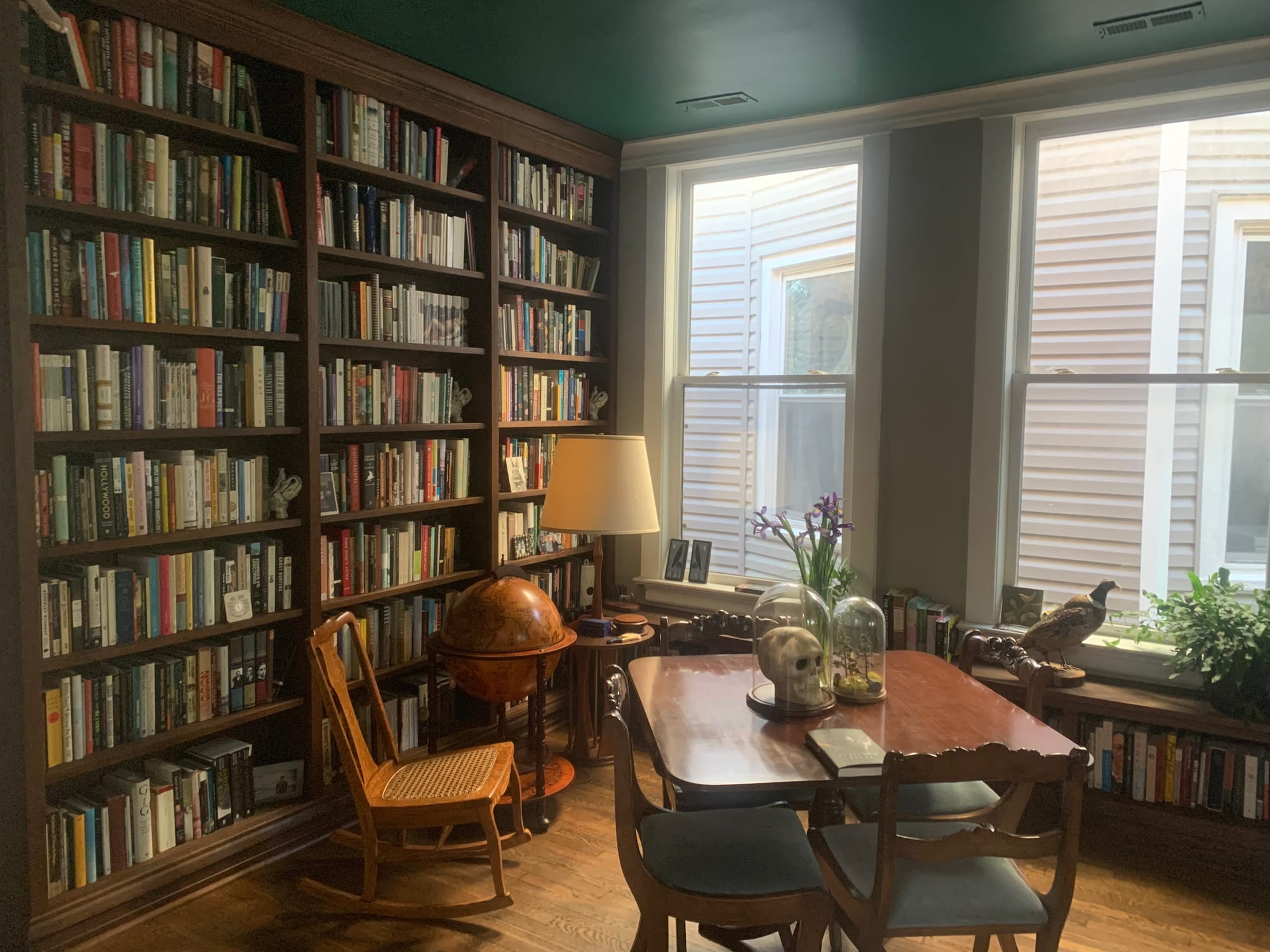
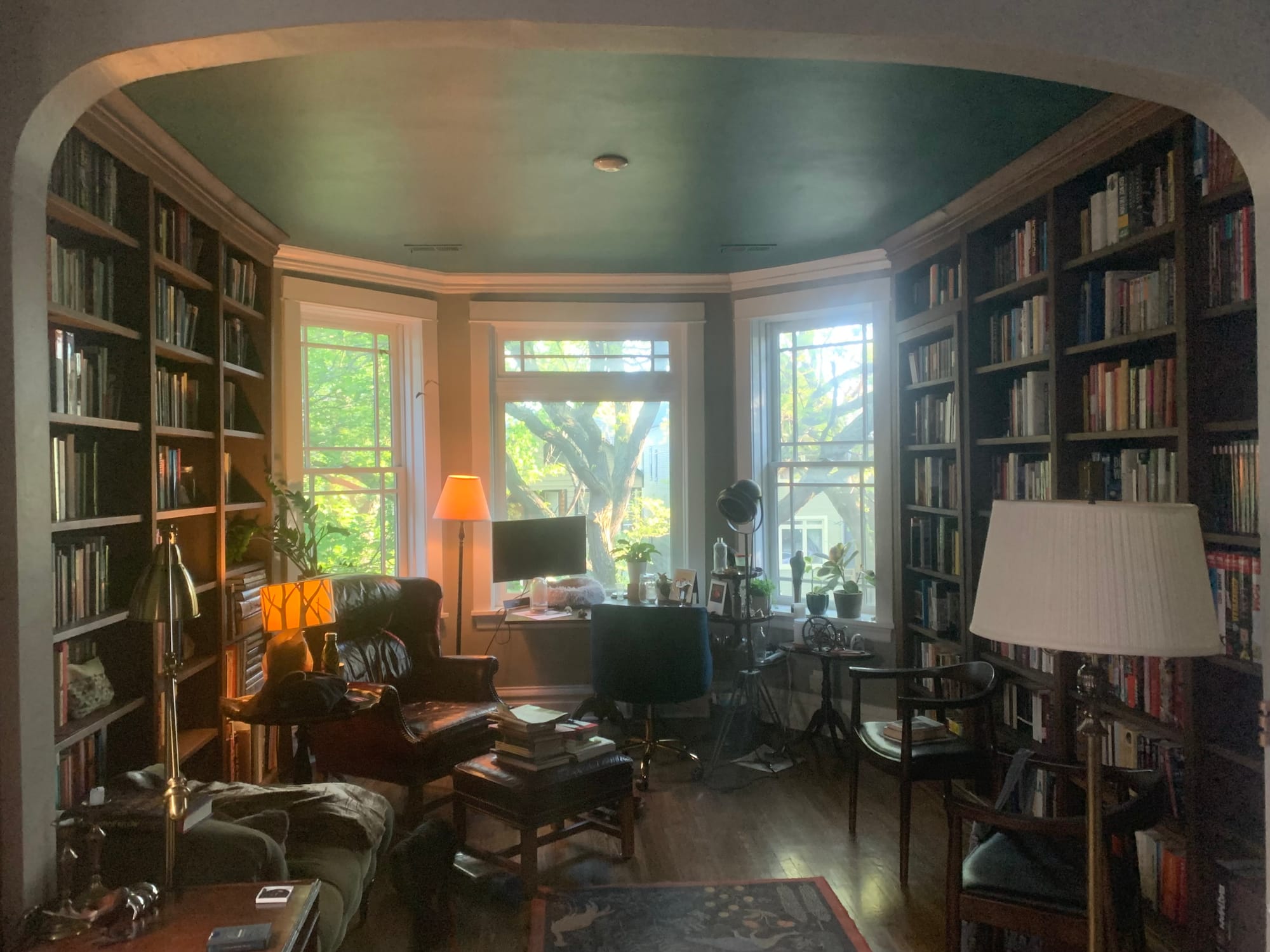
*Stacey and I once designed a board game for our oldest nephew that came with a (completely unrelated to the game’s premise) copy of War and Peace. When game events led the player to have the book, they had to heartily recommend it to another player in order to pass it along. That player would then lose a turn, caught up by Tolstoy's genius.