For this issue, works about summer. Most are fairly modest in their aims, though their pleasures are real. It’s summer. We need not overtax ourselves. This week’s bookstore, to which titles of the in-print books are linked, is St. Louis's Leviathan Bookstore, since their excellent newsletter tipped me off to the Sarah Orne Jewett novel discussed below. They use Bookshop.org for online ordering, though what I do is email them my choices, because then they get the benefit of the whole sale rather than a percentage.
Painting
Downstate (2012), by Darren Oberto
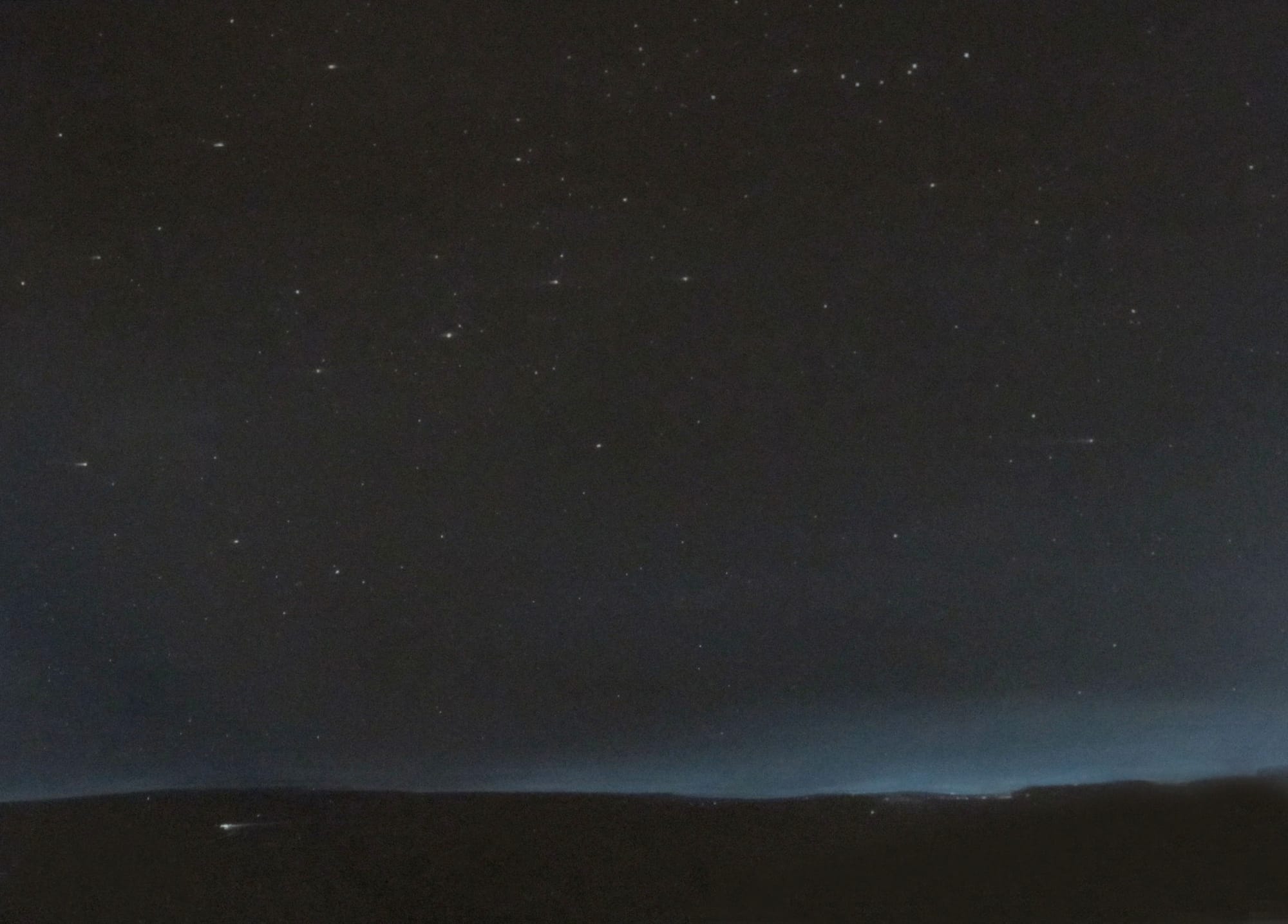
I haven’t written about visual art in this newsletter before. That’s primarily because of my own limitations as a critic. I feel comfortable with my knowledge and critical vocabulary when I’m writing about books, movies, or music, but I’ve never had training in writing about visual arts.
I feel comfortable writing about this painting, however, because it hangs in our stairwell. I have spent a lot of time with it. The image above, provided by the artist, Darren Oberto, makes the best attempt possible to capture it, but the gap between digital image and painted surface is vast. You really should stop by sometime and look at it. The black is rich and deep; the blues and whites and reds tiny but arresting.
You have probably discerned that it’s a landscape. That landscape, for me (and I think for Darren) is the landscape of central Illinois seen from the highway. It’s the trip to see my parents. I don’t know that Darren meant it as a summer scene, but that’s what it is for me, the later stretches of a trip that began in full daylight right after work, then continued as night drew in to the sound of baseball on the radio. (In the actual painting, you can discern the tiny red dots of a radio tower.) It’s a landscape you move through, rather than stay in, though the pinpricks of light you can make out remind us that the countryside is dotted with little fastholds.
I had driven that route countless times without really looking at it before I saw this painting. That’s one of the jobs of an artist, to see something where the rest of us saw nothing.
(To see more of Darren Oberto’s art, several pieces of which grace our house, visit his site.)
Movie
Princess Cyd (2017), directed by Steven Cone
I grew up in the country, three miles from our small town, which meant that after little league ended in June I would barely see my friends until school started again. In the fall I would often find social arrangements and personalities completely scrambled. Someone had been to camp and now had a long-distance boyfriend. Someone else had gotten a mohawk and was super into Danzig now. Another guy had discovered pot and made it his whole identity. It wasn’t even surprising. That’s what you do with the wide-open spaces of summer.
Taylor Swift, in one of her songs about summer and high school, cuts deep by calling it “back when we were still changing for the better.” Adulthood strips summer of that transformative quality, though our alluring memory of it leaves the season with a residual charge. We may be the same self in September that we were in May, but we’ve had that self out and about more, made it more attentive to the world. The growth is like a tree adding a ring, rather than bursting into new leaf or stretching out a limb, but it is growth nonetheless.
Princess Cyd tells both those summer stories. Cyd, a teenage girl whose solo father is at wit’s end, is sent to stay with her aunt, Miranda, in Chicago for a couple of weeks. They’ve not seen each other for years, and Miranda is not a parent, so each has to figure out who the other is, and how they should relate. For the most part, they do that with grace, though the movie effectively reminds us of how lack of awareness, particularly of the compromises of adult life, can make teens breathtakingly, but unintentionally, rude. (One example: Miranda is a writer, and Cyd asks her about one of her books. Miranda starts to tell her, then says she should stop, that a recap isn’t the best way to experience it. “Well I’m not going to read it,” Cyd says. At another point she badgers Miranda about her (lack of a) sex life in a way no adult would on such limited acquaintance.)
Cyd gets a glimpse of cultured, upper-middle-class city life. She experiences a romance. Miranda, meanwhile, forced to see her settled life through young eyes, shows hints of perhaps breaking out of what could be a rut. A comfortable, satisfying rut, but maybe, she starts to see, a rut nonetheless.
And that’s about it. This is a modest film, with modest aims. It achieves them. It’s well made and well acted, but that wouldn’t necessarily be enough to get me to recommend it to you here were it not for the setting.
It’s set in Chicago. Specifically, on the north side, in the neighborhood of Ravenswood Gardens, a few miles from where I live. So what you see in Princess Cyd is not just an interlude in the summer, but an interlude in a Chicago summer. And that’s magical. This movie is full of light filtered through overhanging street trees, backyards with low fences surrounding little patches of grass, lush gardens full of plants ravenously soaking up our short season of sun. We see the beach, and block parties, and a dinner soiree that stretches from twilight into deep night, from living room to cicada-haunted back porch. Summer here is brief, its opposite season brutal, and we make the most of it.
I first knew Chicago from Ferris Bueller. Ferris’s Chicago, however, is tourist Chicago. What we get in Princess Cyd is everyday Chicago, neighborhood Chicago. Roger Ebert used to say how much he liked to see his city on screen, what fun it was to know that people elsewhere were getting to enjoy the beauty we live with. He would have loved this movie. Come spend ninety minutes in my beautiful summertime city.
Book
A Marsh Island (1885), by Sarah Orne Jewett
To the extent that Sarah Orne Jewett is known at all more than a century after her death, it’s for her novella The Country of the Pointed Firs. It tells of a woman’s summer sojourn in a small community in coastal Maine, and I think of it as an late-summer book, full of endings and loss and leave-takings, of regrets and laments for what’s going or gone.
A Marsh Island, while set in late summer, is more early summer in its outlook. It’s an idyll, rather than an elegy. A visitor—in this case a young painter from Manhattan—ends up staying for a few weeks with a family in a remote community on Marsh Island, off Cape Cod. There’s a grown daughter on the farm. A local man has been paying court to her, though with a New England taciturnity that has prevented him from being explicit. The painter, meanwhile, is a Jamesian figure of internal confusion and external ineffectuality. “He had a dim sense of his best self,” Jewett writes, “as if it were a sort of spiritual companionship.” He falls for the daughter, in his uncertain way, while she sees in him a reminder of other paths, of ways to a world off the island. The summer’s events bring matters to a head. That results in no great romance, but also no broken hearts. The book is too down to earth for that. Summer’s changes need not be dramatic to be lasting; clarity itself can be enough.
Jewett is above all else a writer of place, and that also means of season. We get island meadows in high summer, boat trips, carriage rides, the strange work of negotiating the tide to harvest marsh-grown crops. This book, like Princess Cyd, is as much about summer as it is about anything else.
The summer was ripe early this year, and the fruits reddened, and the flowers all went to seed, and the days grew shorter in kindly fashion, being so pleasant that one could not resent the hurrying twilight, or now and then the acknowledged loss of a few minutes of daylight.
An 1885 review in the Literary World links place and season:
It is a sweet and fragrant tale; honest and frank; full of a sylvan loveliness, a rustic freshness, that present the best side of New England to the very life; pure, refined, and wholesome, with the colors of an afternoon in July by the sea, where the blue of the sea and the whitish gray of the beaches and the green of the meadows and the brown of the marsh grass make up an exquisite harmony.
This is a back porch book, a toss-in-your-bag-and-take-to-the-park book. It’s quiet company.
Song
“Summer Holiday” (1963), by Cliff Richard and the Shadows
There’s a time-capsule quality to this lightweight confection. Cliff Richard, crafted by the British music industry to be the answer to Elvis, had by this time had even his ersatz rough edges sanded off. This song, written for the film of the same name, is barely more rock-and-roll than Mantovani. It reached number one in the UK without charting in the United States. (Richard would land a few very modest hits in the States throughout the 1960s, but he wouldn’t reach the top ten until “Devil Woman” in 1976, a single that’s emblematic of the bizarre, multifarious stew that was the 1970s pop charts.) The movie itself would be the number two film of 1963, behind From Russia with Love and ahead of Tom Jones. It was a distinct cultural moment, very much a between-things kind of time.
I first encountered the song in Hook, Line, and Singer, a fakebook of “125 Songs to Sing Out Loud.” The book appears to never have been published in the States, which isn’t surprising because its selection is very English. (“Waltzing Matilda,” “Doing the Lambeth Walk,” “It’s a Long Way to Tipperary,” etc.) My first instinct in playing “Summer Holiday” was to go slow, cut against the cheery lyrics (“We’re all going on a summer holiday. / No more worries for a week or two.”) and emphasize the numerous appearances of minor chords. Not a lament, necessarily, but rather something wistful.
Then I heard Cliff Richards’s version, and, well, I can’t be anything but chipper about the song now. It’s so jaunty, so light, so innocent. In this world, “everybody has a summer holiday,” and the fact that “we’ve seen it all in the movies” is cause for aspiration rather than discontent. It’s June, and the days are at their longest. There will be time for wistfulness and regret come autumn.