As someone who has a professional stake in sales of the Odyssey, I can’t complain overmuch about how it has dominated cultural conversation since the arrival of Christopher Nolan’s film version. I doubt I would complain regardless. Annoying as the more explicitly, performatively outrage-focused portions of that discussion are, ultimately I can't view a situation where a 3,000-year-old poem is the hottest property in town as a bad thing.
But as Hussein Haddaway put it in the introduction to his translation of some of the stories of the Arabian Nights, “there are other fair creatures in the world.” Let’s consider some of them.
Film
Jason and the Argonauts (1963), directed by Don Chaffee
Does auteur theory extend to the special effects guy? Because this is not in any way that anyone cares about a film by Don Chaffee. (Who?) It’s a Ray Harryhausen movie.
You’ve seen clips from this movie. Recognize these guys?
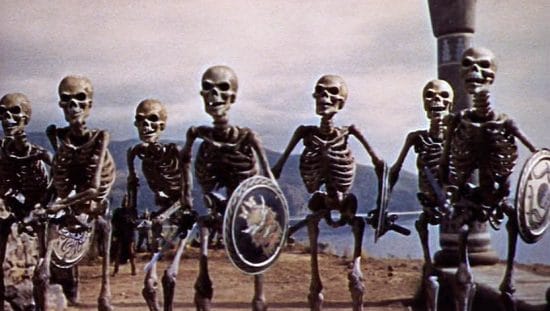
But have you seen Jason fight the Hydra? Triton? The Colossus of Rhodes?
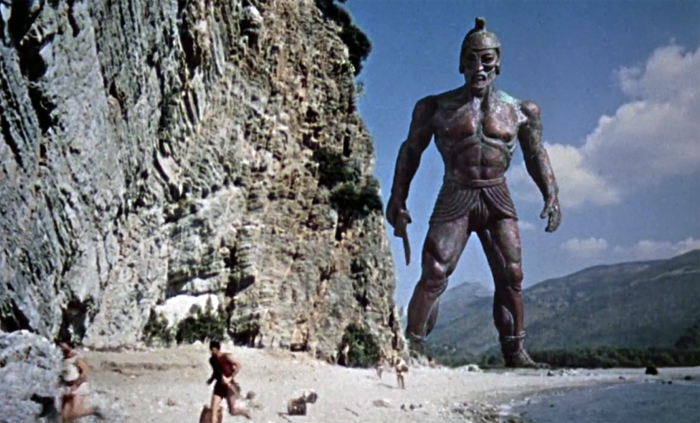
The movie itself is far from good. The screenplay is terrible, the events barely coherent. The performances are almost uniformly bad. The human ones, that is.
Those aren’t the performances that matter, though. You watch this movie for the stop-motion creatures, and they’re dazzling. While never approaching the seamless believability that contemporary special effects aim for (like the practical effects for which Nolan has been lauded), they’re nonetheless wholly convincing on their own terms. Verisimilitude, we could do with reminding ourselves more often, is but one value among many. The one thing the human actors do well is respond with astonishment and terror as these unbelievable beings come after them. The fantastical creatures move distinctively. The skeletons in particular, even as they can’t help but be slightly comic, carry a whiff of the uncanny. Dry bones should not move, let along parry, climb, relentlessly advance. They feel implacable.
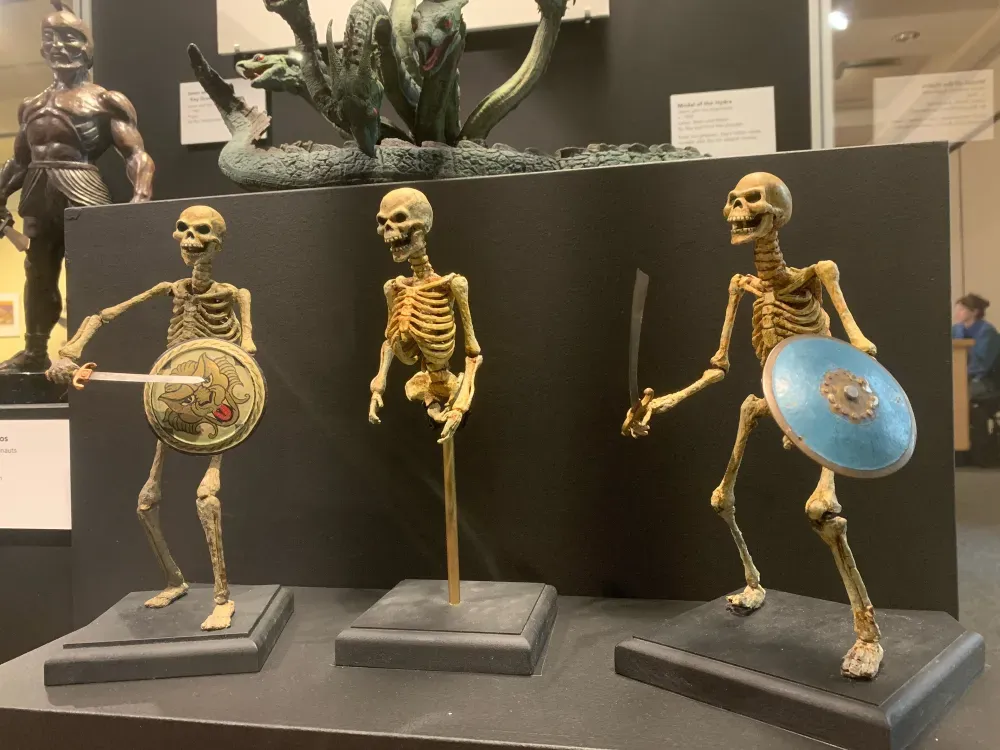
Last winter I got to see a small Harryhausen exhibit at the Kalamazoo Valley Museum, and there was something magical about seeing these models up close. They’re more finely detailed than I had expected, and looking at their points of articulation you could imagine the painstaking work required to breathe life into them for the screen. It felt like being shown the components of a magic spell, and discovering that each component, too, was magical.
One of the best things about Nolan’s Odyssey is how he preserves a lot of the poem’s one damn thing after another quality. The world is strange and little known, full of wonders and horrors. Jason and the Argonauts lets us thrill to a few more of them.
Book
The Aeneid (29-19 BCE), by Virgil
When it comes to the ancient epics, I’m very much an Odyssey person. (Duh. It’s about going home.) The Iliad I admire more than love, though it has its moments. The Aeneid, meanwhile, has always been a distant third, Aeneas a pallid nonentity compared to wily Odysseus or even the angry asshole Achilles.
But oh, there are moments. The most famous of those is Aeneas’s account of, in David Ferry’s translation (for which I handled the marketing), “the story . . . of how the Greeks destroyed the wretched Trojan kingdom and all its wealth. . . . The final agony of Troy.” While the sack of Troy doesn’t appear in the Odyssey, we do get Odysseus’s own account of it in Nolan’s film. And that account is Virgil’s, more or less. It’s a version of the battle as brutal tragedy, the destructive, out-of-control result of ten years of pent-up rage. This may be victory, but it is not heroic. It may even be evil. In Nolan’s film that realization is at the core of Odysseus’s personal struggle.
Aeneas’s account, found in Book 2 of the Aeneid, is harrowing. Here’s Ferry’s version:
Who is it who could tell about such carnage?
Whose tears could be equal to what has happened here?
The ancient city, so long the queen, has fallen.
Dead bodies lying everywhere on the streets,
Among the houses, on the doorsteps, on
The holy portals of the gods. It isn’t only Trojans who have paid the price with blood.
Sometimes some of them, when they could, fought back,
And there are many conqueror Greeks who fell.
Dire woe is everywhere, everywhere terror,
Everywhere there are images of death.
And here’s Robert Fagles’s:
But all in the house is turmoil, misery, groans,
the echoing chambers ring with the cries of women,
wails of mourning hit the golden stars.
Mothers scatter in panic down the palace halls
and embrace the pillars, cling to them, kiss them hard.
But on he comes, Pyrrhus with all his father’s force,
no bolts, not even the guards can hold him back—
under the ram’s repeated blows the doors cave in,
the doorposts, prised from their sockets, crash flat.
Force makes a breach and the Greeks come storming through,
butcher the sentries, flood the entire place with men-at-arms.
No river so wild, so frothing in spate, bursting its banks
to overpower the dikes, anything in its way, its cresting
tides stampeding in fury down on the fields to sweep
the flocks and stalls across the open plain.
Death has come for the people of Troy. As Ferry’s translation puts it:
It’s folly to think the gods are dependable,
When they are not.
The other moment from the Aeneid that stays with me is the suicide of Dido, to which she is driven by Aeneas’s insistence on following his duty and leaving her.
Dido “prays for death,” Ferry translates:
She is weary of looking at
The overarching sky. And to make sure
That what has been begun will be completed
And that she will depart from the light, she saw
As she set out her ritual offerings
Upon the incense-burning altars, how—
the horror!—the holy water darkened and
The wine was changed to an excremental slime.
From Fagles’s version:
So, driven by madness, beaten down by anguish,
Dido was fixed on dying, working out in her mind
the means, the moment. . . .
Dido will not dissolve
into sleep—her eyes, her mind won’t yield tonight.
Her torments multiply, over and over her passion
surges back into heaving waves of rage—
she keeps on brooding, obsessions roil her heart.
The psychology of the characters in Homer is wildly foreign to us. His people believe incommensurately different things about people and the world than we do. But here, six or seven hundred years later, we get an account of a mind gripped by suicidal depression that feels hauntingly familiar. This is a woman who has become tragically convinced that the world has nothing more to offer her, that her dark visions of it are the reality that was long hidden from her. It’s harrowing.
Song
“Didn’t Leave Nobody But the Baby” (2000), by Emmylou Harris, Alison Krauss, and Gillian Welch
Oh, fine, you can sing for a bit about that man after all, Muse.
Before this summer, the most successful recent film version of the Odyssey had been the Coen brothers’ very loose adaptation, O Brother, Where Art Thou? It’s a shambling, often hilarious picaresque that succeeds because of the charisma and charm of its stars, and because of its music.
Oh, that music. The movie is full of new versions of the music of the 1930s American South, music we could easily have lost. Fortunately, restless, road-tripping song collectors like John and Alan Lomax managed to capture a huge amount of music and help keep alive traditions that would otherwise have been subsumed by the homogenizing forces of mid-century America. For many listeners, O, Brother was their introduction to this music, a rural folk music perched between country and gospel, inflected by the Black music that was all around it.
Where that music perfectly intersects with the story of Odysseus is when he meets the Sirens. In Nolan’s film, we don’t hear their song; instead, we get Odysseus’s account of it:
It was the delicious itch you go to scratch but find it’s under the skin, you can’t reach it. So the delicious itch becomes unbearable. Told you what you most want is what you most can’t have. And what you most can’t have is what you already had . . . and lost
The Coens show no such reticence, and their choice of song is brilliant. Even as the Sirens themselves—three young women in white who are washing clothes in a stream—are jaw-droppingly seductive, what they sing is a lullaby. What could be more alluring, in a world that buffets us, where threats lurk around every corner, where failure is the norm and death awaits, than to be told we can go back to being a babe in arms, rocked to sleep, safe and secure?
I’ll close this section with a simpler version of the song, the first I ever heard. It’s sung by Mrs. Sidney Carter and was recorded by Alan Lomax in September 1959 in Senatobia, Mississippi.
Book
The Lost Books of the Odyssey (2010), by Zachary Mason
Let’s close with one more quick note about a book, since we’re on the subject. My copy of this slim book appears to have departed for the beaches of Troy some fifteen years ago. I suppose I’ll give it another five to return before buying a replacement.
Therefore all I have to share is that I remember its Calvino-esque reimagining of the many stories of Odysseus and his companions and enemies as clever, funny, and surprising. Add to that a single passage that I featured on my blog back in 2010. If you like this, you’ll like the book.
Agamemnon had the sleeping Odysseus locked below decks. After sleeping, he searched the hold and, finding nothing, broke into Agamemnon’s cabin (its lock was contemptible). Among weapons, wine cups and trophies of war he found a book called the Iliad. It was the tale of his war and the gist was right but the details were often wrong.
In the introduction he read: It is not widely understood that the epics attributed to Homer were in fact written by the gods before the Trojan war—these divine books are the archetypes of that war rather than its history. In fact, there have been innumerable Trojan wars, each played out according to an evolving aesthetic, each representing a fresh attempt at bringing the terror of battle into line with the lucidity of the authorial intent. Inevitably, each particular war is a distortion of its antecedent, an image in a warped hall of mirrors. The Iliad and the Odyssey have sometimes, through authorial and managerial oversights, become available to their protagonists. Surprisingly, this has had no impact on the action or the outcome. Agamemnon is too obstinate to change his mind and anyway never believes what he reads. Achilles flips through the Iliad and shrugs. Priam makes sacrifices to the nonplussed gods and anyway thinks that he is above prophecy (recall Cassandra). Perhaps there were once characters who read the book with dawning apprehension and fled that very hour, finding refuge in the hills, never again to meddle in the affairs of cities and gods, but if ever there were they are long gone now.
And with that, I’m going to take the month of August off. Among other things, I’ll be sailing the coast of Maine on a windjammer, with my parents and a bunch of strangers. We’ll try not to anger Poseidon. Thanks for reading across this first year of the newsletter. It's been a pleasure to write for you.