Chilly, drenching rains inaugurated autumn over the weekend, just ahead of today’s equinox but I still don’t quite feel like letting go of summer yet.
Music
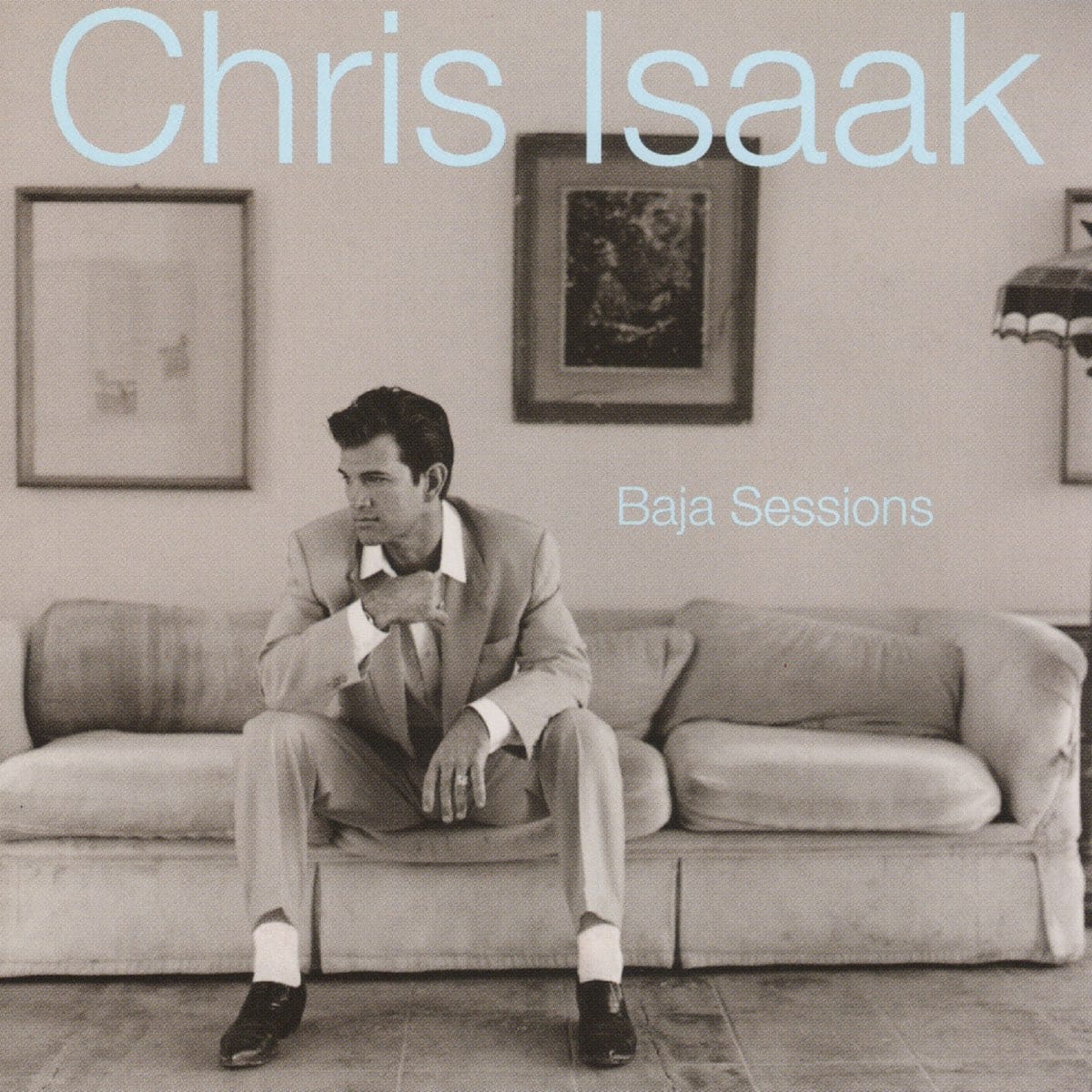
The Baja Sessions (1996), by Chris Isaak
I spend an inordinate time thinking about mass culture, its end, and what it means to live in its absence. I take it as given that there is value to society in having some widely shared cultural knowledge, even if the objects of that knowledge are rarely artworks of the highest order. Our manifold woes would not be cured if we were at least sometimes watching the same channels, listening to the same stations, but I do think we suffer from the loss of that modest bit of binding.
Most of the time when I find myself idly wondering about mass culture it’s not in such a utilitarian way. Rather, it takes the form of: What’s the cultural position of this artwork? Do people like it? Does anyone even know it? We rarely come to culture clean; we almost always have some sense of where an artwork stands when we first experience it. And after my first encounter, I want to know what people thought when the work was new, what they think now. My assessment may not match the consensus, but I’m interested in that relationship, how my understanding aligns or misaligns with that of others, and how it’s sharpened thereby.
Which leads me to the challenge of pitching this album. What is the position of Chris Isaak in 2026? I think he still counts as famous. He was on a sitcom that had his name in the title. Even if it was little watched, that’s a situation where at least some definition of famous surely applies. “Wicked Game” was a top ten hit, back in the final years when that meant you could expect people in general to have heard it.
On the other hand . . . all that was a long time ago. The sitcom is twenty-five years old now, “Wicked Game,” itself a fluke, more than thirty-five. And The Baja Sessions didn’t make much of a splash even when it was new, topping out at thirty-three on the album charts and spawning no hits.
Then there’s the limiting nature of Isaak’s whole deal, which is retro. In his prime he wore a pompadour and used his vocal range like Roy Orbison to sing songs that resemble the better parts of Elvis’s 1960s output, three-minute rock songs with interesting rhythms played by a capable band. A lot of deliberately retro artworks leave me cold, but Isaak’s always felt fully inhabited, a choice rooted in personal preference rather than affectation. But sidestepping the culture, however sincerely, makes it hard to leave an imprint. Mediocre songs that sound like part of their era end up in rotation somewhere. Good songs that don’t can end up wholly forgotten. Which is what I suspect has happened to this album.
It deserves better. Recorded in Baja California, it’s infused with sand and surf and sun. Isaak sings of broken hearts, but how much can even heartbreak hurt in those surroundings? Isaak’s voice has always been an impressive, at times astonishing, instrument, its tone pure California. Listen to his purr on “Back on Your Side,” his octave-plus leap (from a starting point in falsetto!) on “Two Hearts,” the languid sincerity of his rendition of the traditional “Yellow Bird.” His cover of “Only the Lonely” isn’t operatic like Orbison’s; it’s a version calmed by the beach, where the waves will keep coming in and tomorrow will bring another sunset. There’s a warmth and beauty here that draws you in, that can help you hold onto thoughts of summer in the coming months as the sun leaves us.
Film
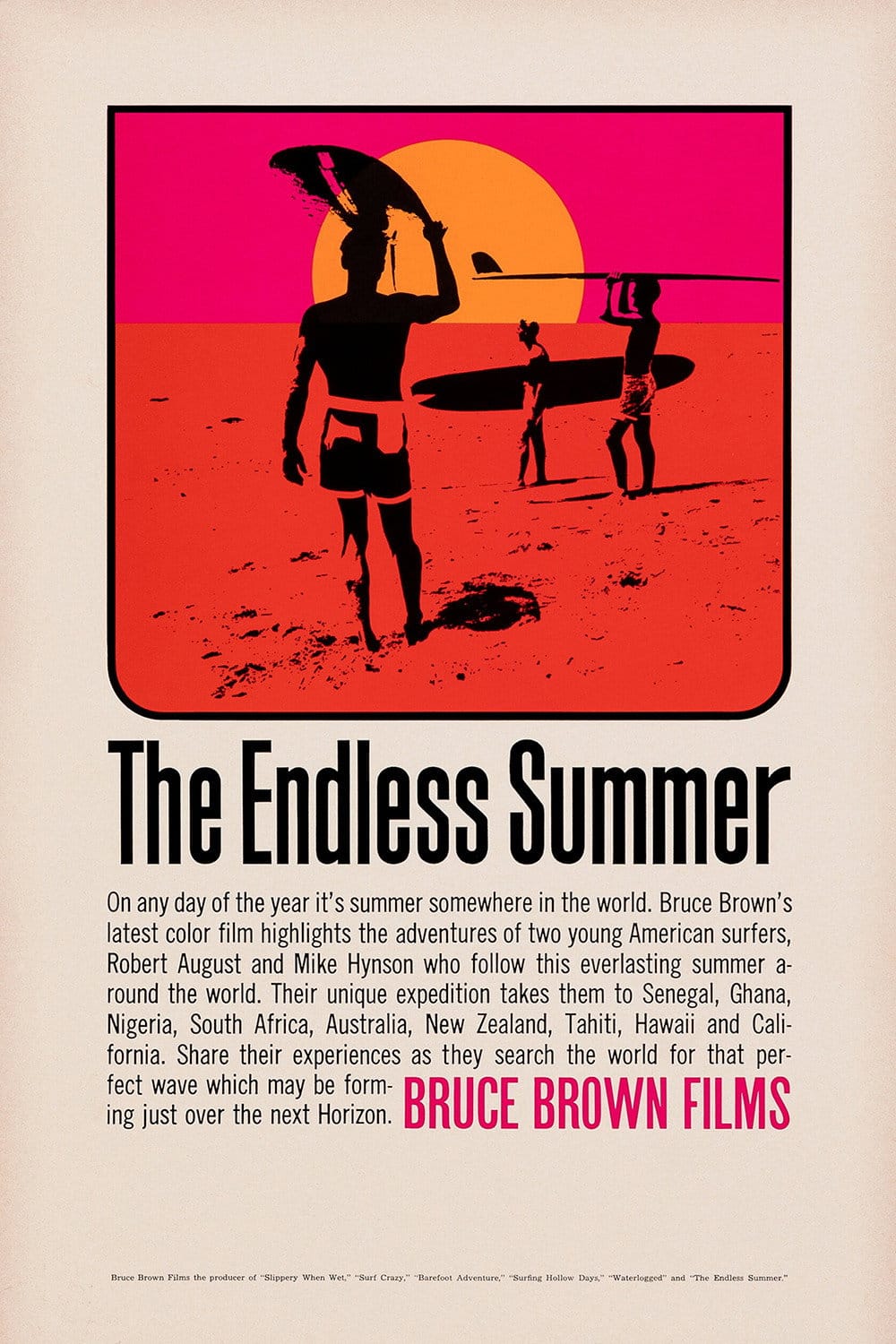
The Endless Summer (1966), directed by Bruce Brown
I noted above that we rarely arrive at artworks clean. But that usually doesn’t extend as far as it did with me and this film. Through years of occasionally coming across this poster or seeing the film referred to, I developed an idea of what it was. What I imagined was functionally an elegy, the story of two surfers—not yet old, but no longer young—refusing to accept the passing of the seasons and setting out on a necessarily futile attempt to defeat time through motion. I imagined surfing, yes, but in the context of regret, chagrin, faltering defiance. An inevitable sunset.
As Harrison Ford said to Mark Hamill on the set of Star Wars: It ain’t that kind of movie. I cannot possibly be too emphatic in saying that is the kind of movie it ain’t. The Endless Summer is just a movie about surfing, and how much fun it is. It may be the most wholly innocent movie I have ever seen. The two young men who are its subjects are basically squares. They wear suits and skinny ties when they travel on airplanes. All they want to do is find good waves and ride them in the company of fun people.
This wasn’t the movie I thought I was setting out to watch, but it turned out to be the movie I needed as summer wound down. The surfing is very well shot, mostly from static locations on the beach but occasionally, thrillingly, from the boards themselves. If you’ve ever surfed, even the tiniest bit, you can feel the action in your core. The locations are gorgeous. The music, by the Sandals, is cheerfully surf-appropriate. And if we might question the innocence at times (like when there’s no notice taken of the fact that everyone they interact with in South Africa is white), it does feel like a genuine product of its time, the last moment before the upheavals of the next few years would change youth culture irrevocably. You can’t outrun time, but if you’re lucky you can preserve a little slice of it forever.
Story
“The Summer People” (1950), by Shirley Jackson
For twenty years now my family has spent a week every summer in a rental house in South Haven, Michigan. Like most of the towns along Michigan’s southwest coast, South Haven is a vacation town that swells with Chicagoans in the summer, then shrinks to a small permanent population with the last leaves of fall. Like locals everywhere, those permanent residents seem to simultaneously appreciate and resent their summer visitors, the town existing in a permanent tension over the question of who it actually belongs to.
Every summer, I think of this story. It’s a simple one, firmly in Jackson’s professional magazine writer mode. As usual, she judges her effects perfectly, giving us only what we need, wasting nothing. Across about fifteen pages she introduces us to a couple from “the city” who decide, for the first time in many years of summering in a rustic cottage outside a rural town, to stay on after Labor Day.
The townspeople take notice.
Administrative stuff
A few issues back, I wrote about the 1973 crime film The Outfit, which is based on Donald E. Westlake’s novel of the same name. The reason I had recently rewatched it was for a project I wasn’t able to talk about then, but am happy to tell you about now: Back in January a video crew came over and interviewed me at home about Westlake’s work and career for the extras of a new UK Blu-ray release of the film. It’s available now, and it’s a really well-made package, with original artwork, multiple essays, and an alternate ending. (I’m on a DVD with Marie Windsor!)
I’d be remiss if I didn’t use this opportunity to also make sure you know about the Westlake book I edited: The Getaway Car: A Donald E. Westlake Nonfiction Miscellany. And while I’m in selling mode—the holidays loom, after all—I’ll also note the book that my wife and I edited together: The Daily Sherlock Holmes: A Year of Quotes from the Case-Book of the World’s Greatest Detective.
The links here, and above to the collection from which “The Summer People” is taken, Come Along with Me, are to Book Moon Books in Easthampton, Massachusetts, a lovely store owned by writers, publishers, and good literary citizens Kelly Link and Gavin Grant.