I apologize for sending this issue twice: I discovered that Ghost had not saved a large number of edits and instead mailed an earlier draft. Grrr.]
Each year about now, I take some time to think about your friends, family, and anyone else who might appear on your holiday gift list. Then, as a service, I present the following, ready to clip and take with you when you, as John Hodgman’s daughter once put it, go to your shops and places.
Would that physical media for movies and music were still prevalent enough that I could safely include them here. Instead, it’s all books.
Unlike people engaged in professional marketing (such as I do in my day job), I’m under no pressure here to stick to what’s new. There are pleasures in the past, many of which will be as if new to plenty of readers. For each pick I also offer an alternative, in case I’ve profiled one of your friends so well that they’ve already got the suggested gift.
Happy holidays, friends. Thanks for enjoying the good stuff with me this year.
For your friend who is one notch on the Affectation Dial away from sporting an ascot
Adrian Tinniswood, The Long Weekend: Life in the English Country House, 1918-1939 (2016)
Would we even enjoy an Edwardian country house weekend? The rooms would be cold and drafty. The bedsheets musty, even fungal. The food questionable. The plumbing primeval. The nearest staircase to your bedroom off limits due to the depredations of the Victorian water ghost. The company? Well, when we hosted a murder mystery dinner party recently I felt obligated to note that were it a real 1930s country house party we wouldn’t have reached the dessert course before someone at the table praised that little man who’s whipping Germany into shape.
Yet the appeal remains. A weekend away in fancy digs but with company and everything taken care of for you. Perhaps there would be a deer park. A mysterious heiress. An ill-behaved but charming dog. Maybe it would be fun?
Adrian Tinniswood brings us as close as we’re likely to get to being able to determine for ourselves.
Alternative: Alison Light’s Mrs. Woolf and the Servants: An Intimate History of Domestic Life in Bloomsbury
For your most misanthropic friend. Which in 2026 is probably a high bar to clear.
Patricia Highsmith, The Selected Stories of Patricia Highsmith (2011)
Sure, they’ve followed Ripley underground and back up again, but they probably haven’t read a story where Highsmith has a cockroach tell us he heard a man shouting “Henry James would turn in his grave!” Highsmith’s stories are, no surprise, vicious and clever, with stings in their tails. She seemed to particularly have fun writing first lines:
Diane’s terror began in an innocent and fortuitous way.
The two other young and unmarried men in the office considered Harry Rowe lucky, very.
It wasn’t merely that Edmund Quasthoff had stopped smoking and almost stopped drinking that made him different, slightly goody-goody and therefore vaguely unlikable.
Edward (Skip) Skipperton spent most of his life in a thunderous rage.
The stories that open the volume, drawn from the collection The Animal-Lover’s Book of Beastly Murder, may be the purest distillation of Highsmith, deeply misanthropic accounts of animals giving humans what they very much deserve. There’s an EC Comics-level fatalism at work here, and watching it play out is extremely satisfying. All naughty, no nice.
Alternative: Muriel Spark’s A Good Comb
For the friend who (reasonably!) never got over Italo Calvino’s Invisible Cities
Marco Polo, The Travels of Marco Polo (c. 1300)
Invisible Cities, my favorite of Italo Calvino’s books, purports to be an account by Marco Polo of the unusual places he encountered on his travels.
Marco Polo’s The Travels of Marco Polo purports to be an account by Marco Polo of the unusual places he encountered on his travels.
From which did I take this passage?
You travel for twelve days by a river, on each side of which lie many towns and castles, and at length you reach the large and handsome city of Chintigui. . . . In this country are . . . to be found the largest and fiercest dogs that can be met with. So courageous and powerful are they, that a man with a couple of them, may be an over-match for a tiger. Armed with a bow and arrows, and thus attended, should he meet a tiger, he sets on his bold dogs, who instantly advance to the attack. The animal instinctively seeks a tree, against which to place himself, in order that the dogs may not be able to get behind him, and that he may have his enemies in front. With this intent, as soon as he perceives the dogs, he makes towards the tree, hut with a slow pace, and by no means running, that he may not show any signs of fear, which his pride would not allow.
Sure, Calvino’s version is headier, more imaginative. But reading Polo’s own accounts you see exactly where Calvino got the unforgettable voice. If you love Invisible Cities but haven’t yet gone beyond it to the source of its sense of wonder, you have delights in store.
Alternative: Zachary Mason’s The Lost Books of the Odyssey
For your friend who is going to drag you to Avengers: Endgame despite, well, you’ve seen the trailer, right? Maybe we could stay home and watch some Fleischer Superman cartoons instead?
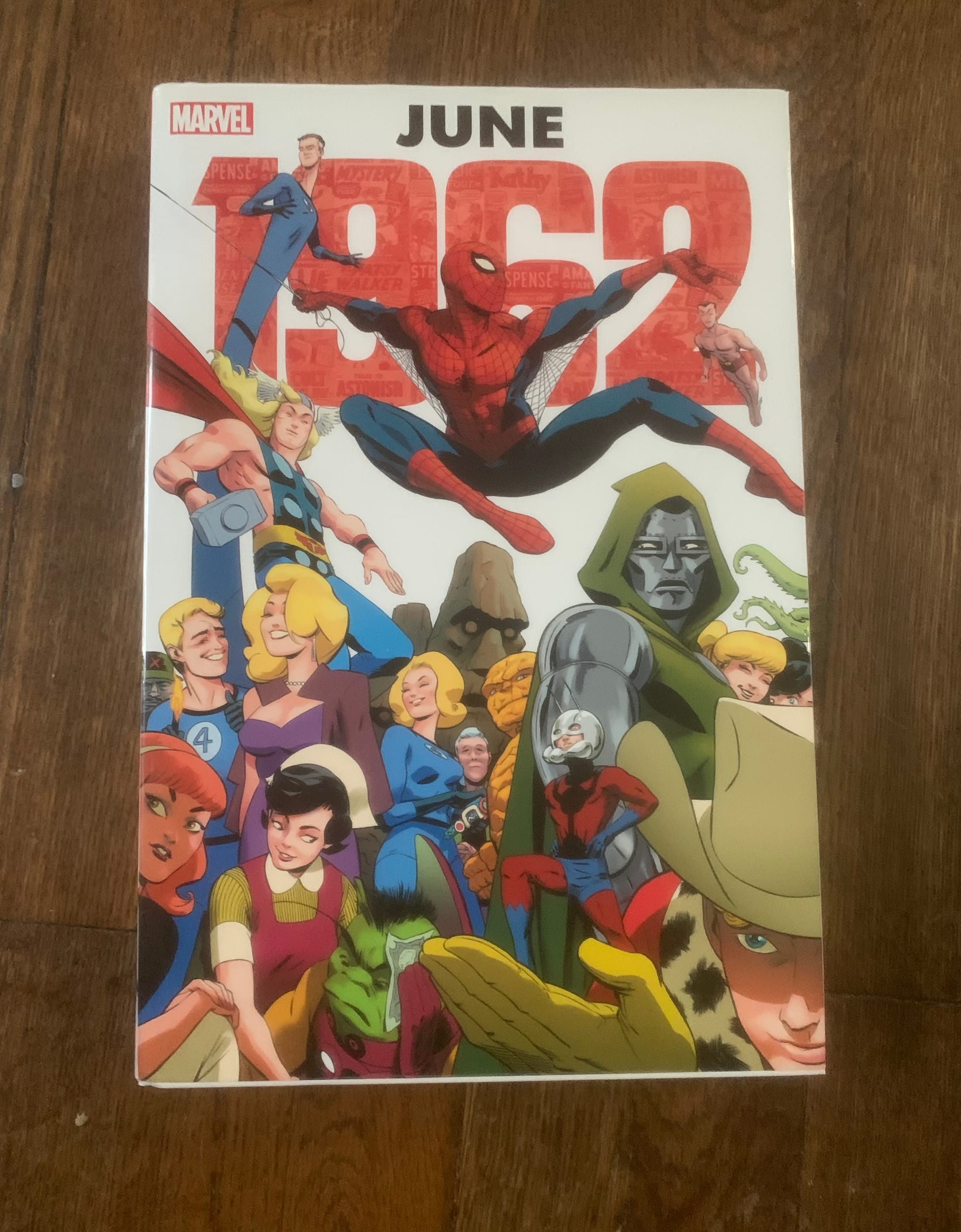
Stan Lee, Jack Kirby, Steve Ditko, et al., June 1962 (2022)
The creation of the Marvel Universe in the first years of the 1960s was a cultural earthquake whose full effects are still being felt more than a half century later. When Stan Lee and Jack Kirby created the Fantastic Four in 1961, they were doing a job of work. When Stan Lee and Steve Ditko created Spider-Man just over a year later, they were doing the same. Little did they realize that the combination of the two, and the idea, initially implicit but soon made explicit, that they existed together in the same version of New York, would transform not just the comics industry, but American culture.
In June 1962, however, when Spider-Man made his first appearance, comic books were still wildly heterogeneous, multifarious. The goal was sales, any sales, to hold that spot on the rack month after month, get that twelve cents from a teen. So alongside the sixth issue of Fantastic Four and the third issue of The Incredible Hulk, Marvel that month published Westerns (Gunsmoke Western; Rawhide Kid; Kid Colt, Outlaw), romance with a heavy dose of fashion (Millie the Model; Patsy Walker; Linda Carter, Student Nurse), and weird tales (Tales to Astonish, Tales of Suspense). This book collects all of them, every comic that Marvel published in June of 1962. Reading them is both delightful—the romance comics dress their heroines in clothes based on designs submitted by readers, with credits!—and sad, as you realize that within a few years the success of superheroes would eliminate nearly all other genres.
(This book appears to currently be out of print, or at least unavailable except from used book dealers. There are some similar volumes, including August 1961, which may be more easily found and would likely serve a similar purpose.)
Alternative: Douglas Wolk’s All the Marvels: A Journey to the End of the Greatest Story Ever Told
For the friend with whom you occasionally get nostalgic about pre-pandemic office life
Ed Park, Personal Days (2008)
Personal Days was published long before the pandemic, when the default for most of us was to be in the office five days a week. Yet it somehow even then was suffused with a nostalgia for the kind of nonsense that can only emerge from the strange combination of time and moderate intimacy that office life generates. What were we all doing there for forty hours a week? (I once had a standing-on-one-foot contest at the office with my colleague Melinda. I lost. Barely.)
Only at the office do you establish which is the Good Starbucks and which the Bad Starbucks. Only at the office do you end up with a Jack II, or with this bit of wisdom he generates:
Jack II says that when you feel a tingling in your fingers, it means someone’s Googling you. We take to this bit of instant folklore immediately.
But Personal Days is ultimately more elegiac than nostalgic. And it’s more funny than anything. Example:
Lizzie drags an icon out of a cluttered corner of her screen but lets go too soon. It falls into the document she’s working on, which happens to be her resume. The icon bounces back to its starting place with a boinggg noise she’s never heard before. She learns that Word cannot insert a file into itself.
Word can seriously go fuck itself, she mutters. She’s been talking to herself a lot lately but maybe we all have.
Later she’s trying to put a chart into a different document but gets scolded: That is not a valid action for footnotes.
This is funny—the quick response, the finger-wagging strictness—but it also creeps her out. She calls up Pru except she accidentally dials her own extension and the little screen says, You cannot call yourself.
Our machines know more than we do, Pru thinks. Even their deficiencies and failures are instructive. They are trying to tell us something about the limits of the human, the nature of the possible. Or something like that, says Pru, who has been reading a novel about cyborgs set in the year 2012.
The message that kills us is the one that pops up on the rare occasions when we remember to shut everything down for the weekend, just before we turn the computer off.
Are you sure you want to quit?
Are you sure you want to work from home?
Alternative: Rona Jaffe’s The Best of Everything
For your friend who enjoys reading about people endangering themselves through travel
Kevin Fedarko, A Walk in the Park: The True Story of a Spectacular Misadventure in the Grand Canyon (2024)
We are repeating a category from last year, because this friend, safely experiencing danger only on the page, has survived another year!
I’m not sure I’ve read of a more ill-advised journey than the one at the core of this book. Kevin Fedarko and a friend decide to hike the entirety of the interior of the Grand Canyon, despite being neither in shape for it nor prepared for it in any other way. Their first night, camped on the rim, they meet with some more experienced through-hikers, who, looking at the Fedarko party’s gear and seeing disaster, toss eighty percent of it. You know the moment near the beginning of A Walk in the Woods when Bill Bryson’s companion is revealed to have packed mostly Snickers bars? Or in The Survival of the Bark Canoe when the canoe builder accompanying John McPhee on their backwoods paddle sinks the canoe to the gunwales with canned food? It’s kinda like that, but for much more dangerous conditions.
The story of how these lunatics survive is braided with the stories of other, better prepared but more lunatic Grand Canyon devotees, many of them sufficiently vivid as to activate my fear of heights even without pictures. Sometimes when you give a friend a travel book you have to first think about the risk that your friend, reading it, will suggest the two of you replicate the trip it depicts. You needn’t worry about that here.
Alternative: Peter Fleming, Brazilian Adventure
For your friend who keeps a stack of books beside their chair for reading with their morning coffee
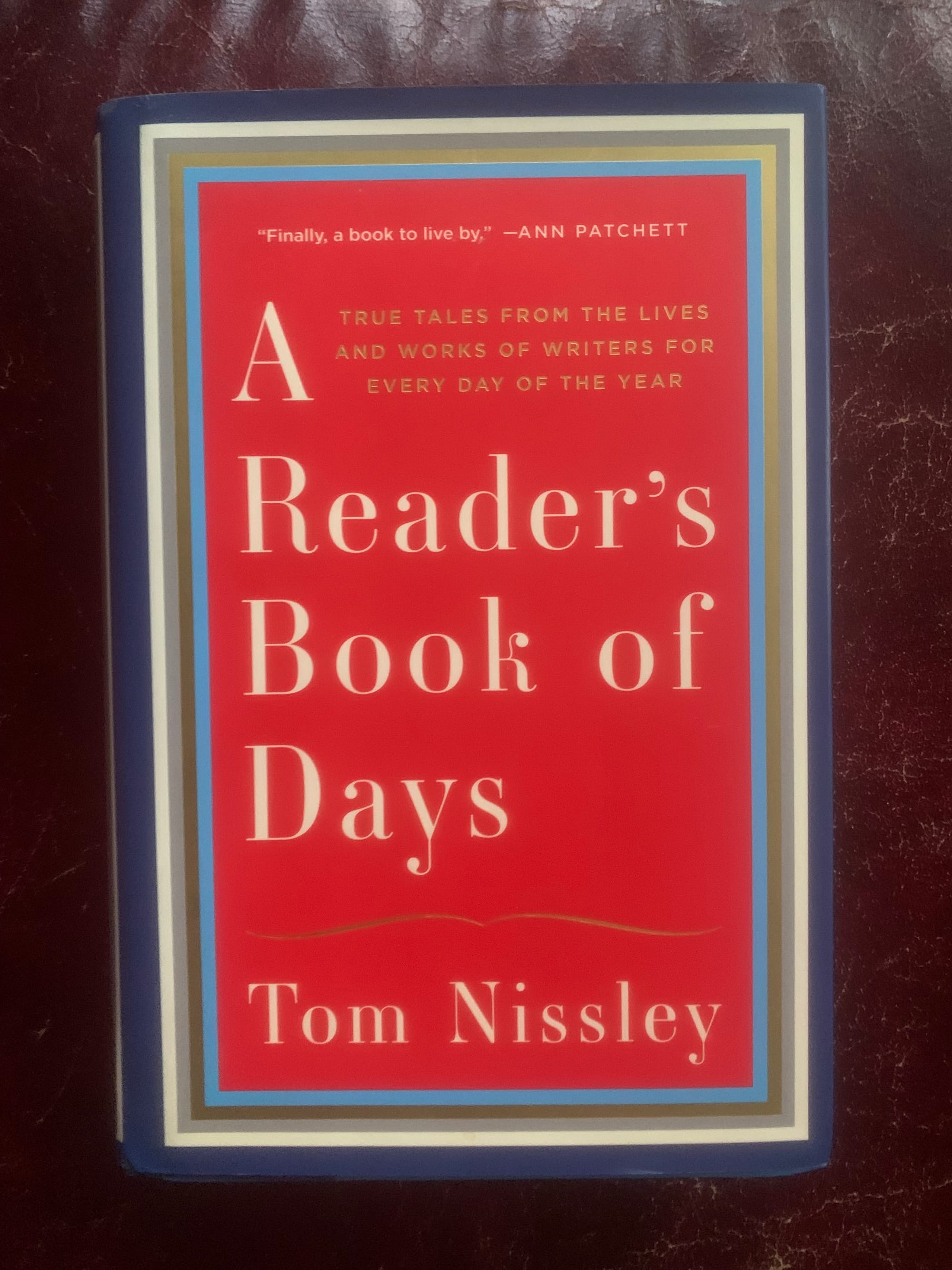
Tom Nissley, A Reader’s Book of Days: True Tales from the Lives and Works of Writers for Every Day of the Year (2014)
Every morning, I read a little bit from a small shelf of what I think of as my daily books. A week of strips from a volume of The Complete Peanuts. An essay by Virginia Woolf. Some poems—currently from a volume of Stevie Smith. It helps me ease into the day. As the poet Alice Oswald (about whom more later) writes, “an hour in the the morning is worth three in the evening.”
This is a book for that shelf. There’s a page for every day. Each lists notable births and deaths and any major works published that day. Then it’s on to the good stuff: Anecdotes from that day involving a wide range of writers.
The day on which I’m writing this, November 18, for example, notes the death of Proust before moving to anecdotes about the Tennysons being suckered into a failed scheme (concocted by the head of an asylum) to machine-produce wooden furniture, a review of the novel Peter Pan by G. K. Chesterton, and crucial scenes from James Ellroy’s American Tabloid and Roberto Bolaño’s The Savage Detectives. It’s the stuff of good cocktail parties and friendly chat, and you don’t even have to leave your chair to enjoy it.
Alternative: Robert Phelps and Peter Deane, The Literary Life: A Scrapbook Almanac of the Anglo-American Literary Scene from 1900 to 1950
For your friend who (finally!) fell for the Odyssey this summer
Alice Oswald, Memorial: A Version of Homer's Iliad (2011)
I’ll let Oswald’s introductory note explain:
This is a translation of the Iliad’s atmosphere, not its story. . . . Ancient critics praised its “enargeia,” which means something like “bright unbearable reality.” It’s the word used when gods come to earth not in disguise but as themselves. This version, trying to retrieve the poem’s “enargeia,” takes away its narrative, as you might lift the roof off a church in order to remember what you’re worshipping. What’s left is a bipolar poem made of similes and short biographies of soldiers.
The Iliad is full of death. Oswald shows us, one by one, what death means, the individual worlds each one forecloses.
Alternative: David Malouf, Ransom: A Novel
For your friend who, like me, is aging into not really wanting to listen to anything but the American Songbook
Ted Gioia, The Jazz Standards: A Guide to the Repertoire (2012)
This is another morning book for me, a collection of short essays—just over a page apiece—on about 250 classics of the jazz canon. The entries vary, with some giving details of a song’s composition or its writers, others exploring technical components, delivered with insight from Gioia’s own experience as a jazz musician. All entries close with a list of versions worth hearing. After a night at the piano, I’ve come to look forward to checking out what Gioia has to tell me about whatever song by Ellington or Porter or Carmichael I’ve been learning.
Alternative: Wilfrid Sheed, The House That George Built: With a Little Help from Irving, Cole, and a Crew of About Fifty
For your friend who, though not exactly believing in its divinatory power, draws a tarot card every morning
John Aubrey, Miscellanies on Various Subjects (1696)
Aubrey is known for Brief Lives, a collection of compact, distinctive portraits of his contemporaries. The same magpie interest in the gossipy stories of others fuels this book, which does what it says on the tin but with an emphasis on accounts of the supernatural, the witchy, the paranormal. Here’s one, taken almost at random:
Mrs. E. W. daughter of Sir W. W., affirms that Mrs. J. (her father’s sister) saw herself, i. e. her phantom, half a year before she died, for a quarter of an hour together. She said further, that her aunt was sickly fourteen years before she died, and that she walked living, i. e. her apparition, and that she was seen by several at the same time. The like is reported of others.
So much here is typical of Aubrey: His stories are frequently second-hand, and often further removed. He doesn’t elaborate, though he will gently belabor; he doesn’t want us confused. And frequently he will adduce the support of unspecified others. He’s giving us urban legends avant la lettre, and they’re a treat.
Alternative: Sylvia Townsend Warner’s Lolly Willowes
For your cattiest friend. Or relative. You’ve got both.
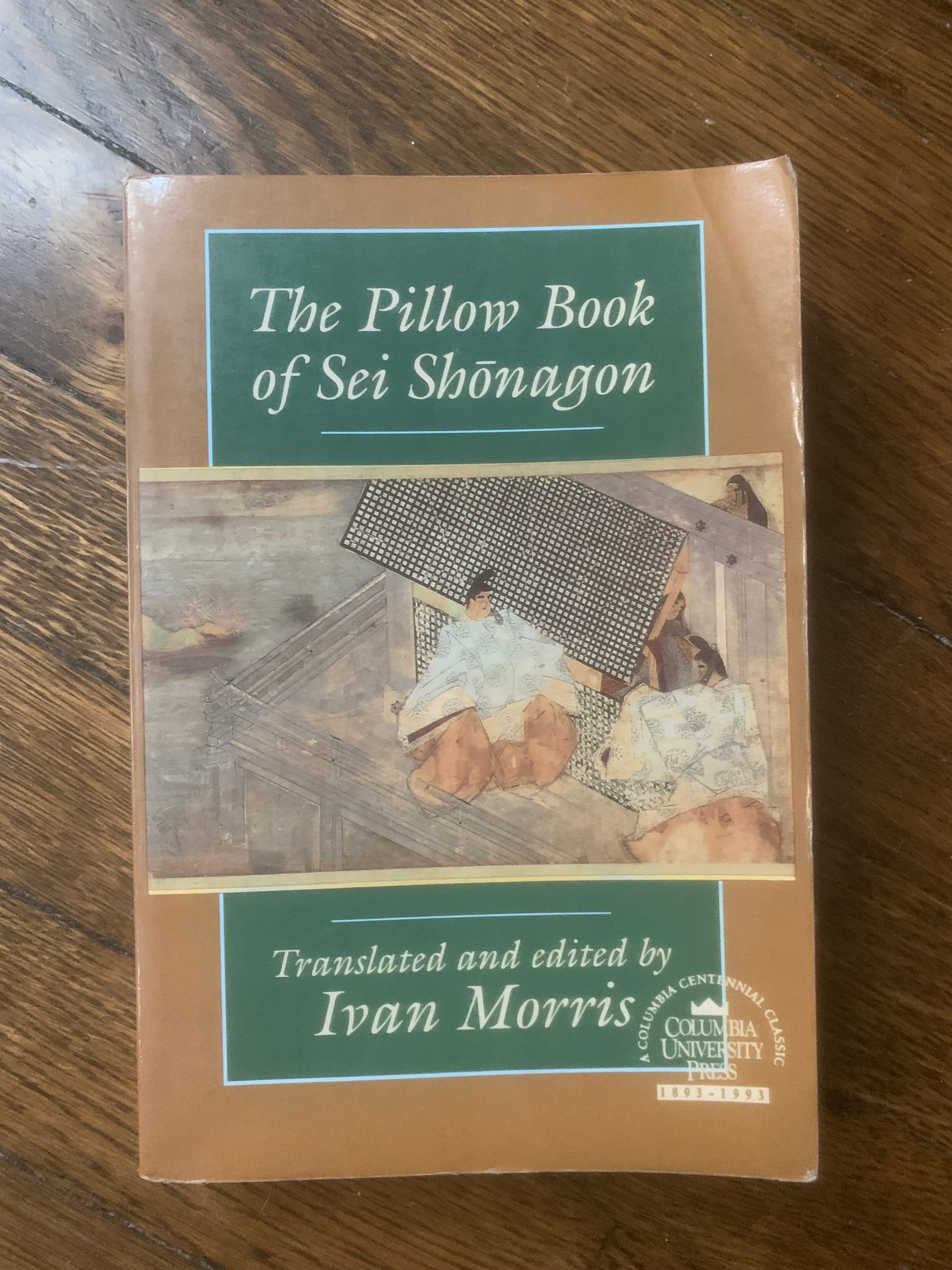
Sei Shōnagon, The Pillow Book (1002)
Sei Shōnagon was a lady of the court in Heian Japan. She wrote the lists, observations, and stray thoughts that make up the Pillow Book for herself, she claimed. But a court is a prying place, and the book circulated in handwritten form during her life, though it didn’t get set into type until the seventeenth century.
It is one of the most engaging, charismatic, distinctive, and idiosyncratic books I know. If you told me Shōnagon was secretly a cat, I’d believe you, as she has a combination of self-confidence, prickliness, and elegance that I’ve only observed in felines.
This is from a list of Hateful Things:
A man who has nothing in particular to recommend him discusses all sorts of subjects at random as though he knew everything.
The centuries between her time and ours shimmer and fade away . . .
Here’s a list of Squalid Things, a good example of how Shōnagon is both an acute and an ungenerous observer:
The back of a piece of embroidery.
The inside of a cat’s ear.
A swarm of mice, who still have no fur, when they come wriggling out of their nest.
The seams of a fur robe that has not yet been lined.
Darkness in a place that does not give the impression of being very clean.
A rather unattractive woman who looks after a large brood of children.
A woman who falls ill and remains unwell for a long time. In the mind of her lover, who is not particularly devoted to her, she must appear rather squalid.
If you can give this book to someone who doesn’t know of it, you’ll do a grand thing.
Alternative: Javier Marias, Written Lives
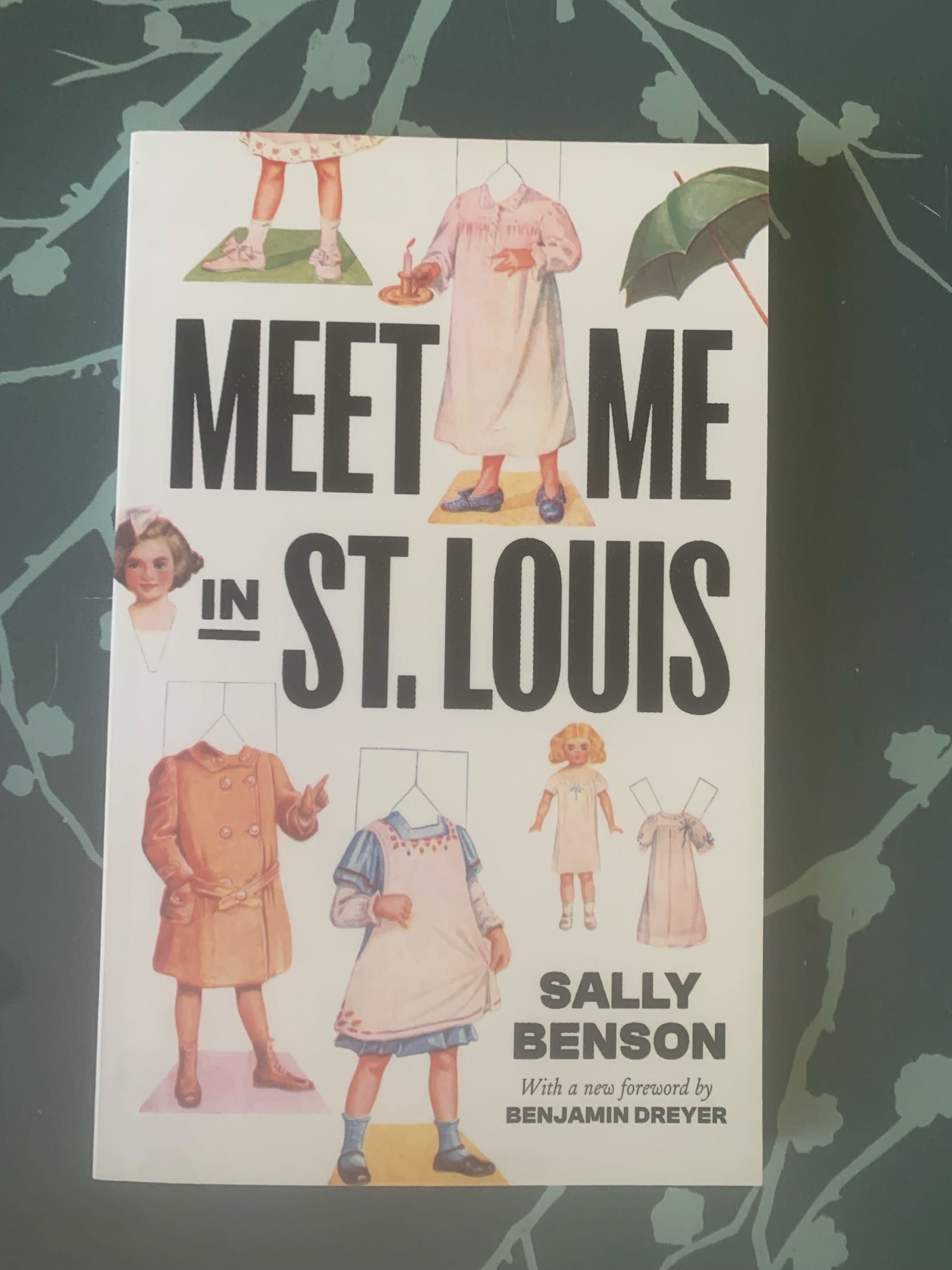
For your friend who watches Meet Me in St. Louis every Christmas (and Halloween)
Sally Benson, Meet Me in St. Louis (1942)
I think this is the first book I’ve formally recommended that is published by my employer. Hopefully you’ve gotten enough sense of my taste and interests to trust that this is a genuine recommendation.
The film of Meet Me in St. Louis is, as Bosley Crowther put it in his 1944 New York Times review, “a warm and beguiling picturization” of New Yorker writer Sally Benson’s book in which she lightly fictionalizes stories from her turn-of-the-century childhood. The book is smart and gentle and funny and sweet without being at all cloying. It’s about family and growing up and a long-lost form of urban life. As Sadie Stein put it in the New York Times Book Review last year, “there’s quite a lot of light-touch poignancy to it.” I love it to pieces. I am so happy that I work at a place that allows me to have a wild idea (“I wonder whether we could reprint that?”) and a year later be able to share a beautifully designed paperback with an insightful and clever foreword by Benjamin Dreyer. This book deserves to be read and remembered like the best works of the other lasting midcentury New Yorker writers.
Alternative: Patrick Dennis’s Auntie Mame: An Irreverent Escapade
Administrative stuff
It’s my practice to link to a different bookstore with each newsletter. This month, I’ve chosen Seattle’s lovely Phinney Books, because it’s owned by Tom Nissley, the author of A Reader’s Book of Days. Phinney Books doesn't have a typical website built for online selling, so the links above are to their affiliate shop on Bookshop.org, which will fulfill orders and give Phinney Books a cut. Alternatively, an email to info@phinneybooks.com with the authors and titles you’re looking for should work as a first step in placing a direct order. Since most of my recommendations are older books, earlier is better for the holidays, since the shop may have to special order them. (And a few of the books above are either out of print (The Literary Life, June 1962) and thus only available from used book dealers, or extremely obscure (Aubrey’s Miscellanies) and thus potentially difficult for a traditional store to source.)
While you’re visiting the Phinney Books site, I recommend you check out Phinney by Post, their monthly book subscription service. Every month they send you a book, alternating between fiction and nonfiction. And I can attest to their taste and breadth of interest: Even though my job for the past thirty years, broadly defined, has been knowing about books, Phinney by Post regularly delivers something I’ve never heard of and am glad to have in my mailbox.
Carried over, with slight modifications, from earlier issues:
Since we’re in holiday mode I’ll remind you about my book projects:
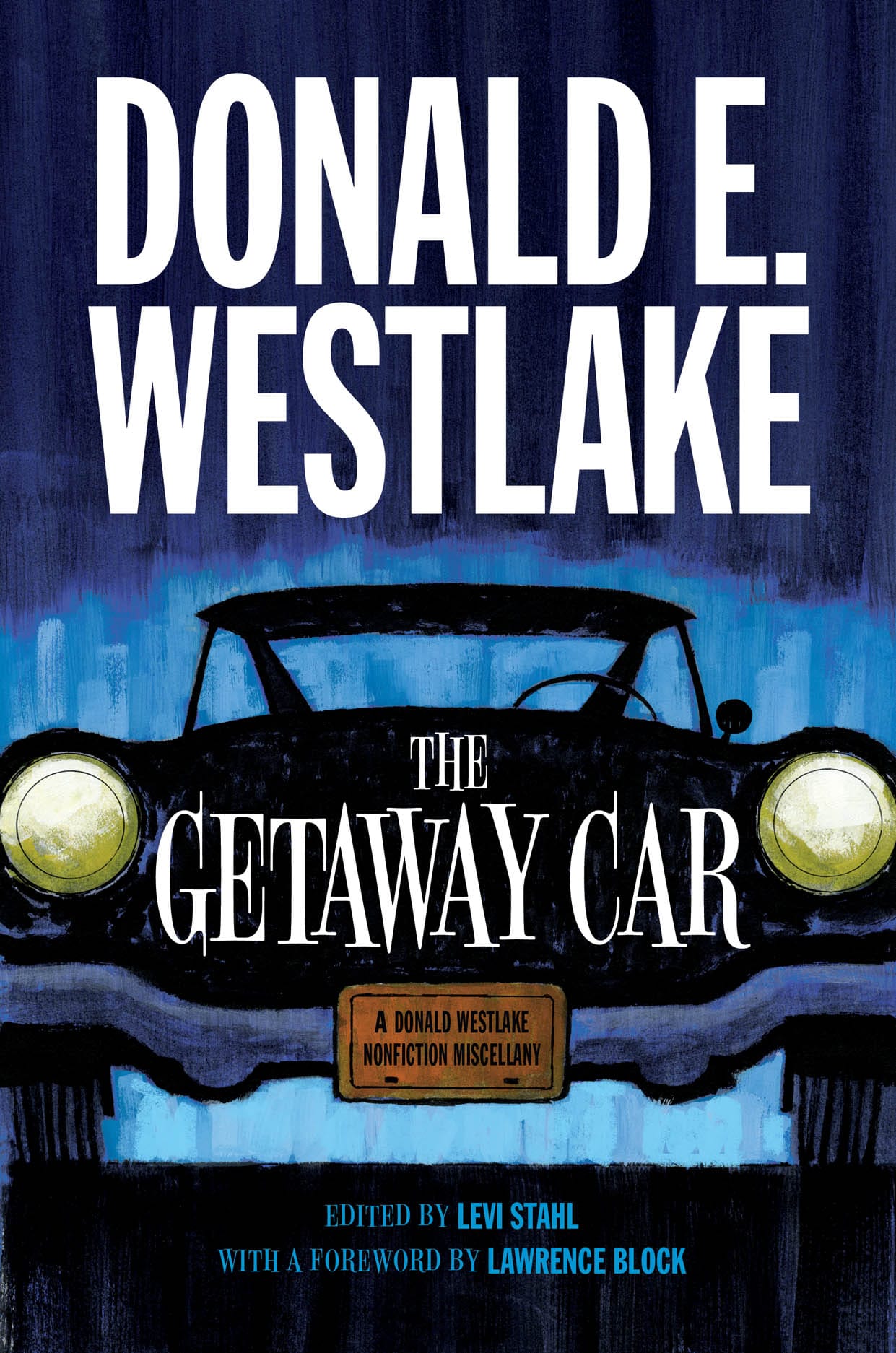
—I compiled, edited, and wrote the introduction to The Getaway Car: A Donald E. Westlake Nonfiction Miscellany. (Which reminds me of another, non-book gift, designed by a friend, that’s perfect for the Westlake fan in your life.)
—My wife and I edited The Daily Sherlock Holmes: A Year of Quotes from the Case-Book of the World’s Greatest Detective.
—I wrote the foreword to Anthony Powell’s early comic novel Venusberg.
Finally: if you’re interested in watching me talk about the work of Donald Westlake, you can do so on the extras of a new Arrow Films Blu-ray of the 1973 film The Outfit, which is based on the Westlake novel of the same name. (I wrote about the film a few issues back. I have not yet watched myself. Eventually.)